Table of content
-
Startup Law in Nepal: Startup Loan Procedure, Eligibility and Legal Framework
01. General Background
Nepal currently does not have a separate "Startup Act". Historically, several efforts to promote and develop startup businesses faced many challenges due to the absence of a dedicated legal framework and ambiguity around the concept of a “startup,” as well as difficulties in accessing finance due to high interest rates and banks requirements for fixed-asset collateral. In the absence of a Startup Act, the Government of Nepal has gradually introduced policies and procedural frameworks aimed at promoting startups, encouraging innovation, and improving access to finance.
Thus, Government of Nepal introduced the Startup Enterprise Loan Operation Procedure, 2025 (2082), to provide a framework for implementing the startup enterprise loan program. The Procedure was formulated by the Ministry of Industry, Commerce and Supplies pursuant to Section 65(1) of the Financial Procedures and Fiscal Responsibility Act,2019 (2076) as part of its broader initiative to promote entrepreneurship, innovation, employment generation, and access to finance for emerging businesses.
The initiative is aligned with the growing global trend of supporting new and technology-driven enterprises. Through this initiative, Government seeks to strengthen Nepal’s startup ecosystem, facilitate access to affordable financing, encourage innovation and investment, and support the sustainable growth of eligible startup enterprises. This scheme is designed for new and growing businesses that bring something innovative or different to the market. This includes startups working in technology, IT, agriculture, manufacturing, tourism, healthcare, education, e-commerce, and other emerging sectors.
02. Startup Policy
The National Startup Enterprise Policy, 2024(2081) was introduced with the vision of developing entrepreneurship through innovative and creative thinking, with the broader goal of creating opportunities for production and employment. The Policy seeks to address existing gaps in the startup ecosystem and provide a policy direction for the development of a more supportive environment for startup enterprises. It sets out policies and strategies, which provide the Government’s policy direction for promoting, facilitating, and developing startups in Nepal. The Policy therefore provides the broader policy framework and government priorities for startup development, while subsequent procedures provide more specific mechanisms for implementing particular government programs, including startup financing.
Key Policies under Section 9 of National Startup Enterprise Policy, 2024(2081)
| a. | Develop the legal, institutional, and necessary infrastructure for a startup ecosystem. |
| b. | Promote startup-based entrepreneurship to increase production and create employment. |
| c. | Encourage domestic and foreign investment in startup enterprises. |
| d. | Promote collaboration among federal, provincial, and local governments and the private sector. |
| e. | Utilize financial tools to make startup enterprises competitive and strong. |
| f. | Establish a separate "Nepal Startup Fund" to ensure resources for startup development. |
Key Strategies under Section 10 of National Startup Enterprise Policy, 2024(2081)
| a. | Amend existing industrial business laws, formulate new startup-friendly legislation, and develop institutional arrangements and infrastructure. |
| b. | Facilitate business incubation centers, accelerator programs, mentor supply, international best practices, and domestic employment creation. |
| c. | Amend relevant laws to attract Foreign Direct Investment (FDI) and Non-Resident Nepali (NRN) investment, and ease startup entry into the capital market. |
| d. | Build coordination, cooperation, and partnerships among innovation programs run by all three tiers of government, the private sector, financial institutions, universities, and incubation centers. |
| e. | Provide financial and non-financial facilities including tax exemptions, seed capital, concessional loans, export cash grants, and technical assistance. |
| f. | Establish a dedicated "Nepal Startup Fund" to provide financial support to startup entrepreneurs. |
Note: Following the adoption of the National Startup Enterprise Policy, 2024(2081), the Ministry of Industry, Commerce and Supplies introduced the Startup Enterprise Loan Operation Procedure, 2082 to put these financial support strategies into practice and regulate the distribution of subsidized startup loans.
03. Startup Enterprise Loan Operation Procedure, 2025(2082)
Definition of a Startup Enterprise
Pursuant to the Section 2 (j) of Startup Enterprise Loan Operation Procedure, 2025/26(2082) "a startup enterprise refers to any private firm, partnership firm, company, or cooperative operating commercially by applying novel innovation, creative thinking, and modern technology to the development, production, operation, or distribution of goods, services, or processes.”
Regulation Authority for Startup Loan Facility
The Industrial Enterprise Development Institute (IEDI) hereinafter referred to as ("IEDI"), under the Ministry of Industry, Commerce and Supplies is the principal agency responsible for implementing the program.
Eligibility Criteria for Applicants
To successfully apply for the startup loan, your business must meet these baseline rules:
-
Type of Entity: Registered as a private firm, partnership firm, company, or cooperative.
-
Age of Business: Must not have been registered for more than 10 years.
-
Turnover Limit: Annual turnover must not exceed NPR 15 Crores in any financial year since registration.
-
Innovative: Must use creative thinking, innovation, or technology in producing goods or services.
However, businesses that are not registered as industries, entities engaged solely in the import and resale of foreign goods, blacklisted firms, and holding or investment companies are strictly ineligible. Furthermore, applicants who have previously received a government startup loan are barred from reapplying.
Eligible Startup Sectors.
To qualify for a startup loan, your business must operate within one of the following five approved government sectors:
-
Agriculture, Forest & Manufacturing: Agriculture, irrigation, livestock, manufacturing, forest/herbs-based ventures, mining research, and food technology/nutrition.
-
Information Technology & Digital: Science, communication, IT, daily-life simplification technology, waste management, and public service/process improvement tech.
-
Infrastructure & Transportation: Safe transport and logistics, infrastructure construction, electric vehicles/automobiles, and distribution systems.
-
Social Services & Tourism: Education and learning, human health services, tourism promotion, entertainment, and hospitality.
-
Traditional & Local Resources: Traditional/rural technology and the revival of traditional professions or enterprises.
Step-by-Step Procedure for Obtaining a Startup Loan
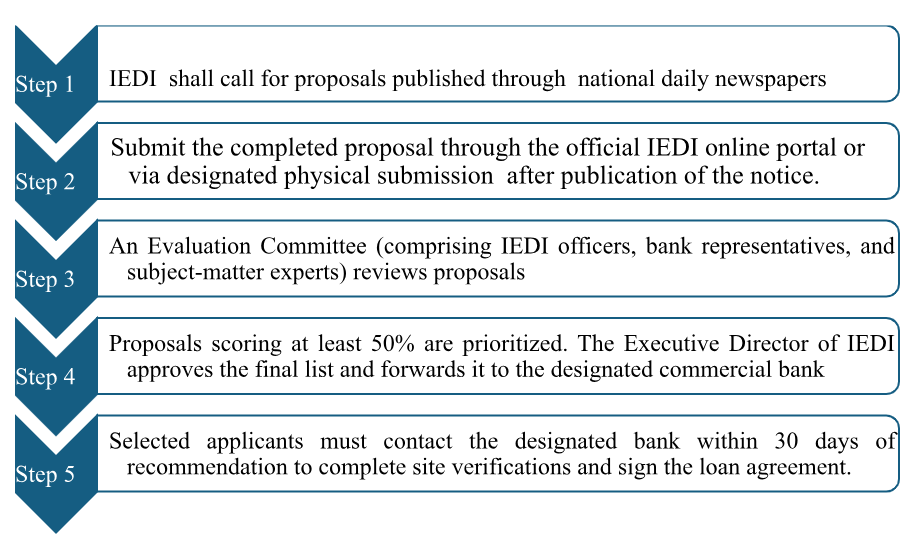
The process for obtaining a Startup Loan involves the following steps:
The process for obtaining a Startup Loan involves the following steps:
Step 1 : IEDI shall call for proposals published through national daily newspapers
Step 2 : Submit the completed proposal through the official IEDI online portal or via designated physical submission after publication of the notice.
Step 3 : An Evaluation Committee (comprising IEDI officers, bank representatives, and subject-matter experts) reviews proposals
Step 4 : Proposals scoring at least 50% are prioritized. The Executive Director of IEDI approves the final list and forwards it to the designated commercial bank
Step 5 : Selected applicants must contact the designated bank within 30 days of recommendation to complete site verifications and sign the loan agreement.
Proposal Evaluation Criteria
Once proposals are submitted for startup loan, the evaluation committee follows the selection criteria as discussed below :
a. Current status of the enterprise/business
b. High growth potential of the enterprise
c. Adoption of technology
d. Source of raw materials used in the project
e. Business proposal presentation
f. Credit appraisal of the enterprise
g. Creditworthiness and Financial Assessment of the Enterprise
h. Existing Employment and Potential for Job Creation
Required Documents for Loan Application
Applicants must submit the following documents during official 21-day call for proposals published by IEDI in national daily newspapers.
| SN | Required documents |
|---|---|
| 1 | Copy of company certificates, industry registration and renewal certificates. |
| 2 | Permanent Account Number (PAN) and previous fiscal year's tax clearance certificate. |
| 3 | Audit report of the previous fiscal year. |
| 4 | Citizenship certificate copy of the official firm/company representative. |
| 5 | Proof or self-declaration of innovation and technology usage. |
| 6 | Annual payroll/salary details of employees from the previous fiscal year. |
Startup Loan Interest Repayment details
The key terms and conditions relating to the Startup Loan, including the loan amount, interest rate, repayment period, service charge, and collateral requirements, are as follows.
| Feature | Detail |
|---|---|
| Loan Amount | NPR 5 Lakhs to NPR 20 Lakhs (based on project evaluation) |
| Interest Rate | 3% per annum (Fixed simple interest) |
| Loan Duration | Up to 5 to 7 years |
| Bank Service Charge | Maximum up to 0.15% |
| Collateral Requirement | Collateral-free (secured against the approved project proposal and credit guarantee mechanisms) |
Agreement and Loan Disbursement
Once the loan is approved, the borrower enters into an agreement with the designated commercial bank. The bank will conduct the necessary field inspection and set out the loan amount, repayment terms, 3% interest rate, disbursement process, and applicable penalties in the agreement.
-
First Installment: 50% of the approved loan amount is generally deposited into the borrower’s account within 7 working days after signing the agreement.
-
Second Installment: The remaining 50% is released after a field inspection confirms that the first installment has been properly utilized and the project is progressing satisfactorily.
-
Grace Period: Repayment of the principal and interest must begin no later than one year from the date of receiving the first installment.
Loan Default, Recovery, and Legal Consequences
Under Sections 16, 17, and 26 of the Startup Enterprise Loan Operation Procedure, 2082, borrowers are expected to use the loan for its approved purpose and comply with the agreed terms. Failure to do so may result in the following consequences:
-
Loan Recall: If the loan is misused or the borrower fails to follow required corrective measures, the bank may require immediate repayment of the outstanding principal and interest.
-
Recovery Measures: In case of default, applicable recovery measures may include freezing of bank accounts or assets and classification of the loan as a Non-Performing Asset (NPA).
-
Blacklisting and Legal Action: In case of fraud, false documents, or other serious violations are involved, the concerned person may face blacklisting through the Credit Information Bureau (CIB) and legal action under the applicable laws of Nepal.
Note: The annual loan allocation and other program details may vary by fiscal year. Applicants should refer to the latest applicable Startup Enterprise Loan Procedure and official notices issued by the Government of Nepal and IEDI before applying.
Date of Publication :9th October 2026
Disclaimer: Bhandari Law and Partners is one of the leading law firm in Nepal with team of best professional lawyers in Nepal . This article published on website of the law firm is just for information purpose only. It shall not be taken as the legal advice, advertisement, personal communication, solicitation or inducement. Bhandari Law and Partners or any of the team members of the firm shall not be liable for the consequence arising of the information provided. As the factual situation may be different on your case, thereof if you need further legal advice on the subject matter, please Contact Us.
Related Professionals:
For quick legal assistance:
You can directly call to our legal expert: +977-9808811027
Even can call or drop a text through What’s app , Viber, Telegram and We Chat at the same number.
Also can do email on : info@lawbhandari.com
Publication
- 1. Labor law in Nepal | Highlights of Labor Act | Latest Guide
- 2. Registration of Non-Governmental Organizations (NGO) in Nepal
- 3. Registration of Company Not Distributing Profits in Nepal
- 4. Cheque Bounce in Nepal : Applicable Legal Remedy
- 5. Establishment of Business in Nepal By Foreign Investors
- 6. Foreign Direct Investment (FDI) Approval Process in Nepal
- 7. Branch Office Registration Process in Nepal
- 8. Liaison Office Registration Process in Nepal
- 9. Company Registration Process in Nepal | Latest 2026 Guide
- 10. Termination of Employment Under Labor Law of Nepal
- 11. Registration of Non-Profit Institution in Nepal
- 12. Trademark Registration in Nepal
contact us
Get in Touch with Our Legal Experts
Have a question or need legal assistance? Fill out our contact form and our team of experienced lawyers in Kathmandu, Nepal will get back to you promptly.
Please include your WhatsApp or Viber number in the phone section if you'd prefer a direct call from one of our legal professionals.
We are here to provide trusted legal support tailored to your needs.
Consult a lawyer in Nepal
Park Lane Road, Buddhanagar-10, Kathmandu, Nepal.
Phone : +9779808811027, +9779849964619
info@lawbhandari.com, nabin@lawbhandari.comConnect with our professional lawyers in Nepal :
Follow Our Law Firm on Social Media :