Table of content
-
Retrenchment of Employees Under Nepalese Labor Law
Overview
In the dynamic landscape of business, organizations sometimes face economic, structural, or technological challenges that necessitate downsizing their workforce. In Nepal, this process, known as retrenchment, is strictly regulated by law to balance the operational needs of the employer with the rights and protections of employees. If a business, organization or company has more than 10 employees then they have to comply with the rules of retrenchment under the Labor Act, 2074 (“Labor Act”)
This article provides a comprehensive overview of the legal process of retrenchment under the law of Nepal.
01. Introduction
In a legal context, retrenchment is not merely a dismissal. It is a form of no-fault termination of employment initiated by the employer due to operational, economic, or structural reasons, such as:
-
The closure of the enterprise or a specific department.
-
A reduction in the volume of business.
-
Technological modernization requiring fewer workers.
-
Economic slowdown or financial hardship.
-
Organizational restructuring.
It is crucial to distinguish retrenchment from termination for cause (such as misconduct or poor performance). Retrenchment is a "no-fault" termination, where the employee is let go not because of any personal fault, but due to the operational requirements of the company.
As per Section 145(1) of the Labor Act, an enterprise may retrench employees where it faces financial problems in its operation, workers become redundant due to a merger, or the enterprise needs to be closed down partially or completely. This process is strictly regulated to protect employee rights and ensure fair practice.
02. Governing Law
The governing laws to regulate the Retrenchment Process includes following:
| S.N. | Governing Laws | Scope |
|---|---|---|
| 1. | Labor Act, 2074 (2017) | This is the principal law governing all aspects of employment relationships, including termination, layoffs, and retrenchment. |
| 2. | Labor Rules, 2075 (2018) | Rule 72 prescribes the procedure to be followed when an establishment that has retrenched workers resumes operation within two years or requires additional workforce. |
03. Legal Grounds for Retrenchment
Retrenchment is not a matter of discretionary decision but is permitted only under specific circumstances defined by law. Under section 145 (1) of the Labor Act, 2074, retrenchment is allowed on the following grounds.
-
Financial Difficulty: The enterprise must be facing genuine financial problems that threaten its solvency.
-
Redundancy from Merger: When two or more enterprises merge into a new entity resulting in duplicate roles and redundant workers.
-
Partial or Complete Closure: When the enterprise decides to shut down a part of its operations or the entire business for any reason.
04. The Retrenchment Process: a Step-by-Step Guide
To ensure legal compliance, an enterprise must meticulously follow process outlined below:
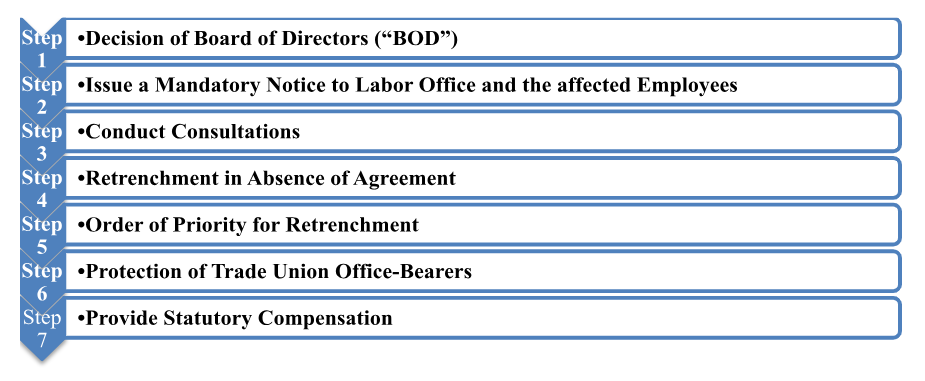
STEP 1: Decision of Board of Directors (“BOD”)
The decision to retrench the employees must be made by the BOD. The Board shall pass a formal resolution and record the same in the meeting minute, clearly stating the reason for such retrenchment and any other relevant details.
STEP 2: Issue a Mandatory Notice to Labor Office and the affected Employees
In accordance with statutory requirements, the employer must provide a written notice to:
-
Labor Office
-
Authorized Trade Union of the enterprise, if any. In the absence of such union, notice must be provided to any trade union active in the enterprise or to the labor relation Committee.
This notice must be issued at least thirty (30) days prior to the intended date of retrenchment. This notice must clearly state the followings:
-
Reasons for the retrenchment
-
Proposed effective date
-
Estimated number of employees to be affected
Additionally, a prior notice of termination due to retrenchment must be given to the affected employees at least 30 days in advance, or in accordance with the Labor Act, 2074, or their respective employment contract.
STEP 3: Conduct Consultations
After issuing the notice pursuant to section 145(2) of the Labor Act, 2074, the employer shall hold discussions with the concerned trade union or Labor Relations Committee regarding alternatives to retrenchment, as well as the grounds and conditions for selecting employees for retrenchment. Retrenchment shall be carried out in accordance with the agreement reached during such discussions.
STEP 4: Retrenchment in Absence of Agreement
If the trade union or Labor Relations Committee refuses to hold discussions, or if no agreement is reached, the employer may proceed with retrenchment after informing the Labor Office of such circumstances.
STEP 5: Order of Priority for Retrenchment
Section 145 (5) of the Labor Act provides that the employees must generally be retrenched in the following order:
-
Foreign employees.
-
Employees who have comparatively received more disciplinary punishments;
-
Employees with comparatively weaker work performance.
-
Employees appointed last among those engaged in similar work (last-in-first-out principle).
However, if it becomes necessary to retrench employees appointed earlier, the employer may do so by clearly stating the reasons.
STEP 6: Protection of Trade Union Office-Bearers
Unless otherwise agreed with the trade union, office-bearers of the Collective Bargaining Committee or authorized trade union shall be retrenched last in order of priority.
Step 7: Provide Statutory Compensation
As per section 145 (7) of the Labor Act, employees who have completed at least one year of service shall be entitled to compensation calculated at the rate of one month’s basic remuneration for each completed year of service. If the service period is less than one year, compensation shall be paid proportionately.
However, employees who are eligible for unemployment allowance under social security laws are not entitled to this compensation.
05. Exceptions From Compliance
Not every enterprise has to comply with the retrenchment process under Labor Act, 2074. An enterprise engaging ten (10) or less than 10 employees is fully exempt from the retrenchment compliance under the act.
Similarly, the procedural requirements relating to prior notice and consultation shall not apply in the following circumstances:
-
Where an enterprise is required to close down, wholly or partially, pursuant to an order of the Government of Nepal or the Labor Court,
-
Where an enterprise operating in a Special Economic Zone retrenches its workforce.
06. Recall of Retrenched Worker
According to Section 146 of the Labor Act and Rule no. 72 of the Labor Rules, 2075, if an enterprise that previously retrenched employees resumes operation within two years or require additional workforce, it must first offer employment opportunities to the previously retrenched workers.
Recall Process:
-
The employer must give at least fifteen (15) days’ notice to the previously retrenched workers.
-
The notice must be published in a national-level newspaper or electronic media, posted on the Ministry’s job portal, and published on the enterprise’s website for at least fifteen (15) days.
-
Workers who respond to the notice may be selected based on qualification, experience and working capacity.
-
If new technology, changes in production methods, or age/physical condition make previous worker unable to perform the work, the employer may hire new worker.
If the retrenched workers do not respond to the notice, the employer may hire other workers. If the employer fails to provide notice or refuses to re-employ eligible workers, the concerned worker may file a case in the Labor Court within thirty-five (35) days.
07. Conclusion
Retrenchment under the Labor Act, 2074 is a structured statutory process intended to balance the operational requirements of an enterprise with the protection of employee’s rights. Employers must ensure strict compliance with the prescribed grounds, procedural requirements, priority rules, and compensation obligations. Non-compliance may result in legal liability and regulatory consequences. Accordingly, careful legal assessment prior to initiating retrenchment is strongly recommended.
Related Professionals:
For quick legal assistance:
You can directly call to our legal expert: +977-9808811027
Even can call or drop a text through What’s app , Viber, Telegram and We Chat at the same number.
Also can do email on : info@lawbhandari.com
Publication
- 1. Labor law in Nepal | Highlights of Labor Act | Latest Guide
- 2. Registration of Non-Governmental Organizations (NGO) in Nepal
- 3. Registration of Company Not Distributing Profits in Nepal
- 4. Cheque Bounce in Nepal : Applicable Legal Remedy
- 5. Establishment of Business in Nepal By Foreign Investors
- 6. Foreign Direct Investment (FDI) Approval Process in Nepal
- 7. Branch Office Registration Process in Nepal
- 8. Liaison Office Registration Process in Nepal
- 9. Company Registration Process in Nepal | Latest 2026 Guide
- 10. Termination of Employment Under Labor Law of Nepal
- 11. Registration of Non-Profit Institution in Nepal
- 12. Trademark Registration in Nepal
contact us
Get in Touch with Our Legal Experts
Have a question or need legal assistance? Fill out our contact form and our team of experienced lawyers in Kathmandu, Nepal will get back to you promptly.
Please include your WhatsApp or Viber number in the phone section if you'd prefer a direct call from one of our legal professionals.
We are here to provide trusted legal support tailored to your needs.
Consult a lawyer in Nepal
Park Lane Road, Buddhanagar-10, Kathmandu, Nepal.
Phone : +9779808811027, +9779849964619
info@lawbhandari.com, nabin@lawbhandari.comConnect with our professional lawyers in Nepal :
Follow Our Law Firm on Social Media :