Table of content
-
Layoff of Employees Under Nepalese Labor Law
01. Introduction
In the dynamic business environment of Nepal, enterprises may face temporary disruptions that affect normal operations. In such situations, Nepalese labor law provides a mechanism commonly referred to as “layoff,” or more precisely, “holding employees in reserve,” allowing employers to temporarily suspend work without terminating the employment relationship. It is important to note that under Nepalese labor law, “layoff” is not synonymous with retrenchment. In common usage, the term is sometimes loosely used to refer to workforce reduction, however, the law clearly distinguishes the two concepts.
Layoff under Section 15 of the Labor Act, 2074 is a temporary measure adopted due to special circumstances, where the employment relationship continues. In contrast, retrenchment under Section 145 of the Labor Act, 2074 involves permanent termination of employment for economic, structural, or operational reasons.
This article examines the legal framework governing layoff (holding employees in reserve) in Nepal under the Labor Act, 2074 and Labor Rules, 2075.
02. Governing Laws
The governing laws to regulate the Layoff includes following:
| S.N. | Governing Laws | Scope |
|---|---|---|
| 1. | Labor Act, 2074 (2017) | This is the principal law governing all aspects of employment relationships, including termination, layoffs, and retrenchment. |
| 2. | Labor Rules, 2075 (2018) | Rule 5 prescribes the procedure to be followed when an establishment that has retrenched workers resumes operation within two years or requires additional workforce. |
03. Legal Definition of Layoff ‘Holding in Reserve’
Section 15(1) of the Labor Act provides that if any special circumstance arises in the workplace, the employer may suspend the work and hold the worker in reserve.
The Act provides an express statutory definition of "special circumstance":
"For the purpose of this Section, 'special circumstance' means a situation involving the shortage of electricity, water, raw materials or lack of financial resources, or inability to reach the workplace or work or operate the workplace because of the occurrence of any situation beyond control."
This definition is exhaustive and restrictive in nature. Employers cannot invoke the reserve mechanism arbitrarily and there must be a demonstrable special circumstance falling within one of the enumerated categories.
04. Grounds of Layoff
A layoff may be initiated only upon the occurrence of a genuine ‘special circumstance’ as defined under Section 15(1) of the Labor Act. The recognized grounds are:
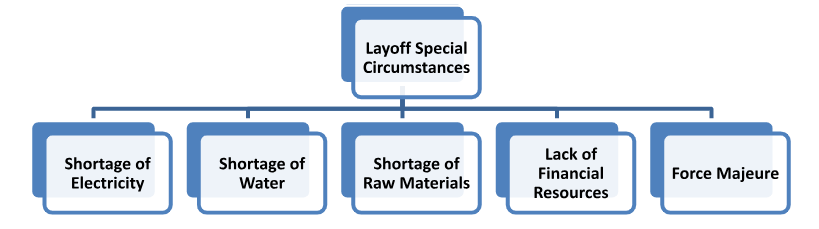
a) Shortage of Electricity: Power disruptions preventing normal operations.
b) Shortage of Water: Water scarcity affecting production or service delivery.
c) Shortage of Raw Materials: Unavailability of inputs essential to carry out work.
d) Lack of Financial Resources: Temporary financial incapacity of the enterprise.
e) Force Majeure: Any situation beyond the employer's control that prevents employees from reaching or operating the workplace.
The grounds must be genuine and documented through board resolutions, utility disruption notices, supply chain records or financial statements. Importantly, a layoff cannot be used as a tool to discipline employees or evade obligations.
05. Key Legal Characteristics of a Layoff
The defining legal characteristics of layoff are:
-
Continuity of Employment Relationship: Under Section 15(2) of the Labor Act, where any worker is held in reserve, the employment relationship between the employer and worker shall continue to exist. The worker is not dismissed, and all accrued service benefits remain intact.
-
Temporary Nature: A layoff is by definition temporary. The law prescribes a maximum initial duration of fifteen days without consultation, and does not contemplate an indefinite reserve period.
-
Reduced Remuneration: Under Section 39 of the Labor Act, employees held in reserve are entitled to half of their basic remuneration throughout the reserve period.
-
No-Fault Basis: Layoff is entirely driven by the operational circumstances of the enterprise.
06. Applicability : Who must comply?
The layoff provisions under Section 15 of the Labor Act, 2074 apply to employers engaging ten (10) or more employees. Section 15(3) of the Act expressly provides that an employer engaging ten or more workers may hold employees in reserve, subject to the prescribed maximum period and consultation requirements.
07. The Layoff Process: A Step-by-Step Guide
To ensure legal compliance, an employer must follow the process outlined below.
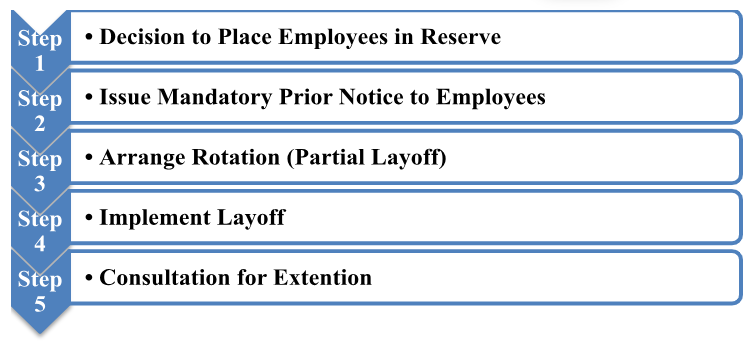
STEP 1: Decision to Place Employees in Reserve
The employer must make a considered and documented decision to invoke the reserve mechanism, clearly establishing the special circumstance that necessitates the suspension of work.
STEP 2: Issue a Mandatory Prior Notice to the Affected Employees
This is a critical procedural requirement introduced by Rule 5 of the Labor Rules, 2075. Before placing any employee in reserve, the employer must give prior written notice to the concerned employee. The notice must disclose all of the following details:
-
The reason for placing the employee in reserve;
-
The duration of the reserve period;
-
The employee's name, position, working branch or unit, and job description;
-
Confirmation that during the reserve period, the employee will receive half of their basic remuneration as per Section 39 of the Labor Act;
-
Any other details the employer considers necessary.
This notice requirement ensures transparency and gives the employee adequate information to understand and, if necessary, challenge the legitimacy of the layoff.
STEP 3: Arrange for Rotation in Cases of Partial Layoff
Where it is necessary to place employees in reserve on a partial basis (i.e., where only some employees in a category are being placed in reserve while others continue to work), Rule 5(3) of the Labor Rules, 2075 requires the employer to:
-
Make arrangements for rotation among employees engaged in similar work, as far as possible; and
-
Mention such rotation arrangements clearly in the notice issued under Step 2.
This provision prevents discrimination and ensures that the burden of the layoff is distributed equitably among employees performing similar roles.
STEP 4: Implement the Layoff- Maximum Initial Period
Under Section 15(3) of the Labor Act, an employer engaging ten or more workers may hold employees in reserve for a period not exceeding fifteen (15) days without further consultation.
STEP 5: Consultation for Extension beyond 15 Days
If the special circumstance persists and it becomes necessary to continue the reserve period beyond fifteen days, the employer must consult with the authorized trade union or the Labor Relations Committee of the enterprise before extending the layoff.
08. Deployment of Reserved Employees to Other Units or Institution
Rather than leaving reserved employees completely idle, Rule 6 of the Labor Rules, 2075 expressly permits and encourages the deployment of reserved employees to other departments, units, or institutions under the same enterprise during the reserve period. The following safeguards apply to such deployment:
-
The employee cannot be assigned work of a lower grade than their current position without their consent.
-
The employee cannot be made to work for remuneration or benefits lower than what they were receiving at the time of the reserve.
-
Where a valid reason other than those listed in Section 15(1) prevents the enterprise from operating on a particular day or time, the employer may deploy the employee on an alternative day or time instead.
-
Any deployment must not violate Section 28 of the Labor Act (which regulates working hours a maximum of 8 hours per day and 48 hours per week).
09. Application to Employees Engaged through Labor Supplies
Rule 6(5) of the Labor Rules, 2075 clarifies that the layoff mechanism also applies to employees who were engaged through a labor supplier. Where such employees are placed in reserve, the labor supplier institution must be informed of the reserve status of its placed employees. Under Rule 6(6), employees placed in reserve in such circumstances are entitled to receive their remuneration and benefits from the employer as per the Act and the Rules.
10. Remuneration During the Reserved Period
Throughout the entire reserve period, the employer is obligated to pay each reserved employee half of their basic remuneration as provided under Section 39 of the Labor Act. All other terms of employment continue to apply, including the accrual of service for gratuity and provident fund purposes, as the employment relationship remains subsisting.
11. Rights and Remedies of Employees
11.1 Rights of Employee During Layoff
During the reserve period, the employee retains the following rights:
-
The right to receive prior written notice before being placed in reserve, with full details as required by Rule 5 of the Labor Rules, 2075.
-
The right to receive half of their basic remuneration during the reserve period under Section 39 of the Labor Act.
-
The right to continuity of the employment relationship with no interruption to the accrued service period.
-
The right not to be assigned lower-grade work or reduced remuneration during deployment to another unit, without consent.
-
The right to be consulted, through the trade union or Labor Relations Committee, if the layoff is to extend beyond fifteen days.
-
The right to be recalled to work once the special circumstance ceases.
11.2 Remedies for Illegal Layoff
A layoff becomes illegal if:
-
It is initiated without a genuine "special circumstance" as defined under the Act.
-
The employer fails to issue the mandatory prior notice as required by Rule 5 of the Labor Rules, 2075.
-
The employer fails to pay the prescribed half-remuneration during the reserve period.
-
The employer uses the layoff mechanism to avoid the retrenchment process or to target specific employees.
-
The layoff is extended beyond fifteen days without consultation with the trade union or Labor Relations Committee.
-
An employee deployed to another unit is assigned lower-grade work or lower remuneration without consent.
In such cases, the affected employee may pursue the following remedies:
-
Complaint to the Labor Office: An initial grievance may be filed with the Labor Office
-
Appeal to the Labor Court: The employee may file a claim before the Labor Court, which may order payment of withheld remuneration, reinstatement, back wages, or additional compensation.
12. Differences Between Retrenchment and Layoff
Given the common confusion between the two concepts, the following table summarizes the key legal distinctions:
| Aspect | Layoff (Reserve) - Section 15 | Retrenchment - Section 145 |
|---|---|---|
| Nature | Temporary suspension of work | Permanent termination of employment |
| Employment Relationship | Continues to exist | Terminated |
| Grounds | Special circumstances such as force majeure, shortage of raw materials, fuel, electricity, or other operational difficulties | Financial difficulty, merger, or partial or full closure of enterprises |
| Prior Notice | Notice to affected employees required (Rule 5, Labor Rules) | 30 days' prior notice to the Labor Office and trade union/labor relation committee |
| Maximum Duration | Up to 15 days without consultation; extension requires consultation with the trade union or labor relation committee | Not applicable, as retrenchment is permanent |
| Remuneration / Compensation | Employee entitled to half of the basic salary during the layoff period (Section 39) | Employee entitled to compensation equivalent to one month's basic salary for each completed year of service |
Related Professionals:
For quick legal assistance:
You can directly call to our legal expert: +977-9808811027
Even can call or drop a text through What’s app , Viber, Telegram and We Chat at the same number.
Also can do email on : info@lawbhandari.com
Publication
- 1. Labor law in Nepal | Highlights of Labor Act | Latest Guide
- 2. Registration of Non-Governmental Organizations (NGO) in Nepal
- 3. Registration of Company Not Distributing Profits in Nepal
- 4. Cheque Bounce in Nepal : Applicable Legal Remedy
- 5. Establishment of Business in Nepal By Foreign Investors
- 6. Foreign Direct Investment (FDI) Approval Process in Nepal
- 7. Branch Office Registration Process in Nepal
- 8. Liaison Office Registration Process in Nepal
- 9. Company Registration Process in Nepal | Latest 2026 Guide
- 10. Termination of Employment Under Labor Law of Nepal
- 11. Registration of Non-Profit Institution in Nepal
- 12. Trademark Registration in Nepal
contact us
Get in Touch with Our Legal Experts
Have a question or need legal assistance? Fill out our contact form and our team of experienced lawyers in Kathmandu, Nepal will get back to you promptly.
Please include your WhatsApp or Viber number in the phone section if you'd prefer a direct call from one of our legal professionals.
We are here to provide trusted legal support tailored to your needs.
Consult a lawyer in Nepal
Park Lane Road, Buddhanagar-10, Kathmandu, Nepal.
Phone : +9779808811027, +9779849964619
info@lawbhandari.com, nabin@lawbhandari.comConnect with our professional lawyers in Nepal :
Follow Our Law Firm on Social Media :