Table of content
-
Advertisement Law in Nepal: Legal Requirements, Rules and Penalties
01.Introduction
The sale and consumption of goods and services are significantly influenced by advertising and brand image. Advertisement ensures communication of the products and services to the consumers. However, if left unregulated, advertisement practices may give rise to misleading advertisements, unfair competition, unethical practices or other forms of malpractice.
In order to regulate and control advertising in Nepal, few dedicated legislative frameworks have been developed and enforced accordingly. The principal legislation being Advertisement (Regulation) Act, 2076 (2019), which seeks to regulate the content, manner and dissemination of advertisements in Nepal.
02. Legal Framework Governing Advertisement in Nepal
For the regulation and management of Advertising of goods, services, program or opportunities, the following frameworks play a significant role in their management, process, approval and other regulatory compliance mechanism;
| Laws | Details |
|---|---|
| Advertisement (Regulation) Act, 2076 (2019) | This Act defines, regulates and determines matters concerning advertisement in Nepal. It also sets out the obligations and roles of the advertiser and the advertising agency, while simultaneously defining the offences and punishment for legal omissions and violations. |
| Advertisement (Regulations) Rules, 2077 (2020) | The Rules make provisions primarily concerning the Advertisement Board, along with matters related to complaint and examination of acts defined as an offence under the Advertisement (Regulation) Act, 2076 (2019). |
| Consumer Protection Act, 2075 (2018) | This Act is dedicated to the protection of the rights of consumers, which also seeks to regulate misleading and false advertisements that can hamper consumer protection practices. It restricts the release of false and misleading advertisements as a prohibited trade practice, with provisions for fines and potential legal action. |
| Competition Promotion and Market Protection Act, 2062 (2007) | This Act prevents anti-competitive advertising practices that can distort market competition and affect healthy competition in Nepal. |
| National Advertisement Policy, 2083 (2026) | With the objective of developing and expanding the advertisement field in Nepal, making advertisements ethical, competitive and transparent, and guaranteeing consumer rights, this policy has been introduced as a national policy framework concerning advertisement in Nepal. |
03. Definition of Advertisement
In general terms, advertisement is understood as a method of marketing goods and services to the public for its exposure and strong market presence. It involves the communication of information relating to the goods and services to the public for promotion and public awareness. This general understanding has been further re-defined and elaborated through Section 2 (e) of the Advertisement (Regulation) Act, 2076 (2019).
Section 2 (e) defines advertisement broadly to include, words, sentences, image, pictures, symbols, posters, pamphlets, light, sign, structure, or any kind of audio, visual or audio-visual material that is disseminated publicly, or has been prepared for such purpose. This is done through print, electronic media, online platforms, social media, hoarding boards, balloons, or any structure and other such mediums, in relation to any goods, services, program or opportunity. This broad statutory definition reflects the different forms and manners through which advertisement can be made.
The Advertisement Act, in its entirety, regulates the different forms of advertisement which includes prints, electronic, online and other outdoor displays. It also sets out the different obligations and liability of advertising agencies, as well as advertisement providers. Further, the act also defines the type, form and nature of advertisement which is permitted and prohibited.
04. Authorities Governing Advertisement in Nepal
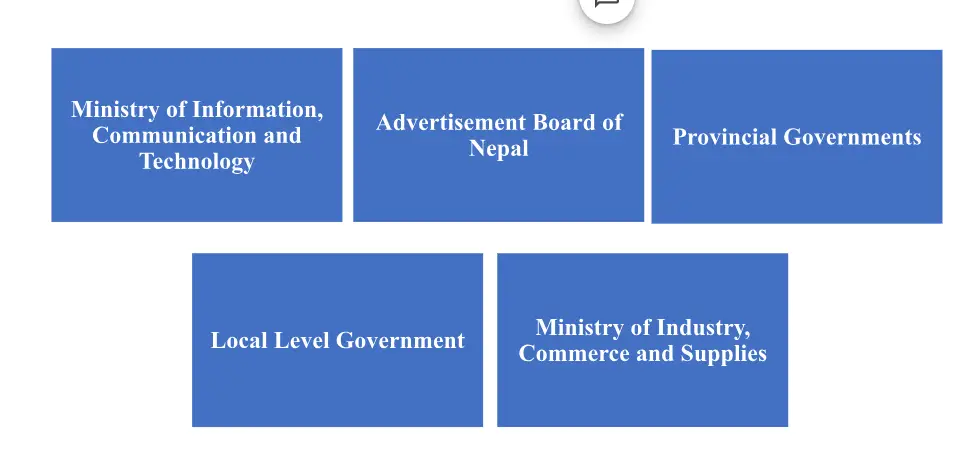
The above-mentioned governmental bodies and institutions have been assigned with different responsibilities in relation to advertisements, depending on the nature and subject matter of the advertisement.
Here, the principal regulatory authority is the Advertisement Board of Nepal. The Board has primary responsibility for regulating advertisements and is also responsible for functions including the preparation of standards and policies; development, publication and dissemination of advertisements relating to public interest; monitoring compliance; coordination between government, advertising agency, advertisers, media and government institutions; and issuing instructions to producers, manufacturers, distributors or broadcasters of advertisement.
The other authorities are also involved in the regulation and monitoring, depending on the nature and type of advertisement concerned.
05. Enlisting of Advertising Agencies
It is mandated that all media outlets and advertising agencies be listed with the Advertisement Board. The licensing process requires the submission of an application in the format prescribed in the schedule of the Advertisement (Regulation) Rules, 2077, along with a fee of Rs. 5000 (Five thousand).
The application must be accompanied with the following information:
-
Certificate of registration obtained with the objective of carrying out advertising related activities and, documents displaying its renewal;
-
Tax Clearance Certificate up to the previous fiscal year;
-
Details showing annual transaction and the capital structure of the agency; and,
-
Other details as specified by the Board.
Upon verification of the application and the details submitted, the Board will list the agency and make it public.
Note: An enlisted advertising agency must complete the process of renewal every fiscal year. If this is not completed, the listing shall be cancelled.
06. Permitted and Prohibited Advertisement
The Act has defined the forms of advertisement which are permitted and prohibited in Nepal. This ensures that the advertisement regime in Nepal remains well-regulated and transparent, without malpractice or false advertisement that hampers social integrity and consumer rights.
6.1. Permitted Advertisement
In accordance with Section 3 of the Act, an advertisement can be made in the following circumstances, by specifying the quality or characteristics of the goods or services;
-
For the purpose of promotion of goods or services,
-
For providing information to the customers regarding the choice of good or services,
-
For providing information to the public about any program or opportunity, and
-
For dissemination of information on matters of public interest.
6.2. Prohibited Advertisement
In a similar manner, Section 5 has prohibited making advertisement on certain matters. They include the following:
| S.N. | Matters where Advertisement is Prohibited |
|---|---|
| a. | Matter encouraging production, sale, distribution, use or consumption of any goods, substance or services that is prohibited by the prevailing laws of Nepal. |
| b. | Matter encouraging gambling or purchase or sale of a lottery that has not been authorized by the law. |
| c. | Matter encouraging use, consumption or promotion of any obscene matters or any other related matters, goods or services. |
| d. | Matter encouraging the production, sale, distribution, use or consumption of weapons or explosive substances, or other similar goods or substances that are capable of posing a threat to the security, peace and order of Nepal. |
| e. | Medicines to be sold only with prescription. |
| f. | Goods or services that require approval for sale, distribution or use under the prevailing laws of Nepal, where such approval has not been obtained. |
| g. | Matters where advertisement has been prohibited by the prevailing law. |
| h. | Advertisement on school and university textbooks, provided that this shall not prevent dissemination of educational information. |
| i. | Matters that promote superstition. |
Further, Sub-section (2) of Section 5 also prohibits advertisement made in the following manner, or which can cause the following:
| S.N. | Forms or Manner of Advertising Prohibited |
|---|---|
| a. | Advertisement which undermines the sovereignty, territorial integrity, nationality or independence of Nepal, and the harmonious relations among the Federal units, public peace, public order or international relations. |
| b. | Advertisement which incites sedition, contempt of court or commission of an offence. |
| c. | Advertisement which diminishes the dignity of the National Flag, National Anthem, National Emblem or National Luminary, or advertisement made through the use of any or all parts thereof. |
| d. | Advertisement that causes defamation. |
| e. | Advertisement which is contrary to public decency or morality. |
| f. | Advertisement which shows disrespect towards labor, or incites gender discrimination or caste-based untouchability. |
| g. | Advertisement which disrupts the harmonious relations among people on the basis of religion, class, sex, caste, ethnicity or community or discriminates on the basis of economic status, language, ideological belief, disability or any other ground. |
| h. | Advertisement which uses trademarks, patents, designs or other industrial property without permission or consent of the right holder. |
| i. | Advertisement which discourages or undermines domestic or any other products. |
| j. | Advertisement which spreads confusion, rumors or agitation or engagement in any other similar indecent behavior. |
| k. | Advertisement which adversely affects fair competition. |
| l. | Advertisement which portrays another person’s goods or services as inferior or of poor quality through comparison. |
| m. | Advertisement which discloses information on matters that are confidential under law. |
| n. | Advertisement which is contrary to the prevailing law. |
In addition to this, a person cannot make or cause the making of any advertisement in a manner that adversely affects the fairness of an election or causes obstruction in the election.
07. Hoarding Board
Hoarding Boards refer to a medium used for the purpose of advertisement which encompasses digital displays, moving image boards, LCD boards, LED Boards, roller boards, glow boards, neon signs, projectors, stall displays and other similar types of advertising media. In order to advertise through Hoarding Boards in a location visible through a public place, a permit must be obtained from the concerned local level.
For this purpose, an application must be submitted at the local level, where necessary investigation shall be made by the office. If deemed appropriate, a permit shall be issued for the specified period of time. Upon lapse of the time period, the Hoarding Board must be removed.
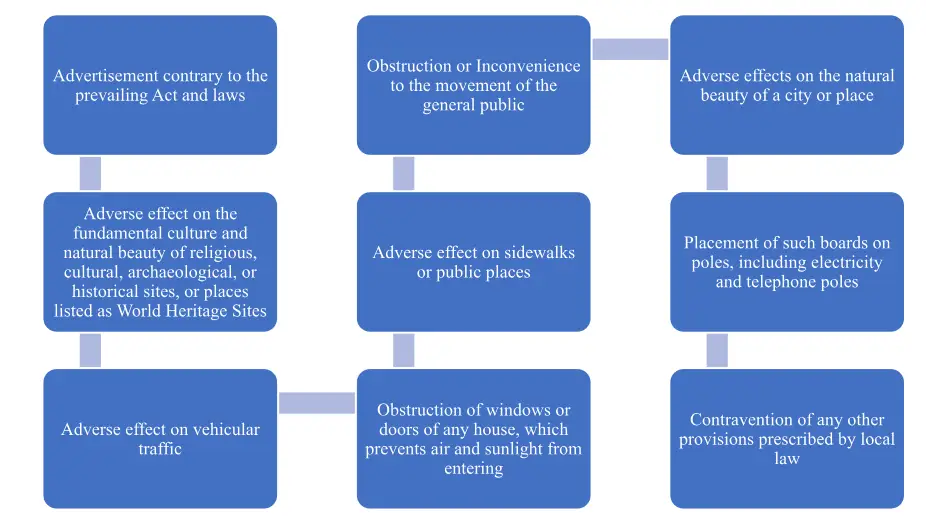
7.1. Where Permit shall not be given
08. Clean Feed Policy for Foreign TV Channels
The Advertisement (Regulation) Act, 2076 provides another significant provision concerning the requirement of maintaining clean feed, particularly by foreign TV Channels. This means that Foreign TV Channels cannot display any advertisements, and guarantee a completely clean feed when broadcasting in Nepal. This provision applies to both recorded and live feeds.
| Clean Feed Requirement | Details |
|---|---|
| Foreign TV Channels in Nepal | Broadcast without any advertisements. |
| Prohibition on Dubbing | Nepali media cannot dub foreign ads and broadcast them. |
| Transition Period | One year from the commencement of the Act for existing contracts. |
| Monitoring | Advertisement Board measures the parameters of foreign channel broadcasts. |
| In Case of Violation | Matter referred to the Ministry of Communication for further action. |
09. Social Media Advertisement
The digitization of modern trade and transactions has also seen a surge in increasing online advertisements, particularly through different social media platforms. The Advertisement (Regulation) Rules, 2077 provides that advertisements made through online mediums or social media shall be regulated by the Advertisement Board.
For the purpose of this regulation, the following shall be taken into consideration:
a. Whether or not the advertisement has been made through authorized channels;
b. Whether or not the advertisement is consistent with the Act and Regulations;
c. Whether or not the advertisement was made through listed communication mediums or listed advertising agencies in the Advertisement Board.
10. Surrogate Advertising
When Companies try to bypass legal restrictions on the advertising of certain products, and use different techniques and mechanisms to do so, this practice is known as surrogate advertising. For instance, this is triggered when companies try to advertise a different product using a similar color scheme, brand identity, name and logo in a manner that is very similar to a product where advertising is prohibited.
The intention here, is to remind customers of the prohibited products indirectly, by utilizing the legal loopholes. Till date, the laws of Nepal have not made express provisions to prevent this form of advertisements.
11. Enforcement, Complaints and Remedies
For offences committed under the Advertisement (Regulation) Act, 2076, the steps for the case initiation to its completion are as outlined below:
11.1. Complaint to be Given :
Any person may provide information to the Advertisement Board; Monitoring and Regulation Committee; or, the local level in written form or through electronic means, if advertisement has been made contrary to the provisions of the Act.
11.2. Inquiry into the Complaint:
An inquiry shall be made into the complaint by the relevant authority. If the complaint is found to be genuine, the authority conducts questioning, orders for submission of documentary evidences and conduct on-site inspections.
11.3. Initiation of the Case:
| S.N. | Offences under the Act | Authority to Initiate the Case |
|---|---|---|
| 1. | For Offences outlined in Section 25 (2) | Where there is a separate provision in the law outlining the process for initiation of the case, then, that shall be followed. If this has not been specified, then the case shall be initiated by the Government of Nepal, acting as the plaintiff. |
| 2. | For offences outlined under Section 25 (3) (a) | Authority to investigate, hear and decide on the case rests on the judicial committee of the related local level. |
| 3. | For offences under Section 25 (3)(b)(c) | Authority has been conferred to the Advertisement Board. |
11.4. Verdict upon examination of all documents and conclusion of hearings:
Upon examination of the documents and conclusion of the hearings, the relevant authority provides a verdict on the case. The decision may result in acquittal of the charges or, may lead to fine punishment or imprisonment, if guilt is proven.
11.5. Provision of Appeal:
If the verdict is not satisfactory, the party can appeal against the decision in;
i.) The High Court, if the case was initiated and decided upon by the District Court;
ii.) The District Court, if the decision was given by the Advertisement Board; and
iii. )The District Court, if the decision was given by the Monitoring and Control Committee and local level.
12. Offences and Penalties
The Advertisement (Regulation) Act, 2076 specifies certain violations of the Act as offences and prescribes corresponding penalties. Section 25 provides that a person who publishes or causes the publication of an advertisement, contrary to Section 4 (1), Sections 5 to 12 commits an offence under this Act.
12.1. Offences under the Act
The offences covered by this Section include:
a. unauthorized advertising through a hoarding board;
b. advertising on prohibited matters or in a manner prohibited by law;
c. broadcasting foreign television channels with advertisement in violation of the clean feed requirement;
d. advertising in a prohibited place;
e. advertising outside the prescribed time where, a specific time has been allocated;
f. advertising without mentioning the advertiser, the advertiser’s address and the required cautionary message;
g. sending advertisements through email or SMS without the recipient’s consent;
h. failure to comply with the process and standards prescribed by the law;
i. publication of an advertisement by a publisher without obtaining authentic information about the advertiser or the advertiser’s address.
12.2 Penalties
For the acts outlined above, the offender can be ordered to comply with the following;
| Offence | Punishment |
|---|---|
| Contravention of Section 5(1) or (2) | Where punishment is prescribed under the prevailing law, punishment shall be imposed accordingly. Where no such punishment is prescribed, imprisonment up to one year or fine up to NPR 10,000, or both. |
| Contravention of Section 4(1) | Fine up to NPR 100,000 (One Lakh). |
| Contravention of Section 6 | Fine up to NPR 500,000 (Five Lakh). |
| Contravention of Section 7, 8, 9, 10, 11 or 12 | Fine up to NPR 100,000 (One Lakh). |
12.3 Provision of Compensation
If any person incurs loss or is gravely affected by the advertisement done, or an advertisement is done using someone’s creation without the creator’s consent, the person can claim for compensation through an application submitted to the Advertisement Board. An examination into the application is made, where if loss is found, the Board orders for compensation to be provided to the petitioner by the advertiser.
Date: 9th October, 2026
Disclaimer: Bhandari Law and Partners is one of the premier legal firms in Nepal with team of best professional lawyers in Nepal. This article, cheque bounce in Nepal published on website of the law firm is just for information purpose only. It shall not be taken as the legal advice, advertisement, personal communication, solicitation or inducement. Bhandari Law and Partners or any of the team members of the firm shall not be liable for the consequence arising of the information provided. As the factual situation may be different on your case, thereof if you need further legal advice on the subject matter, don't hesitate to get in touch with Us.
Related Professionals:
For quick legal assistance:
You can directly call to our legal expert: +977-9808811027
Even can call or drop a text through What’s app , Viber, Telegram and We Chat at the same number.
Also can do email on : info@lawbhandari.com
Publication
- 1. Labor law in Nepal | Highlights of Labor Act | Latest Guide
- 2. Registration of Non-Governmental Organizations (NGO) in Nepal
- 3. Registration of Company Not Distributing Profits in Nepal
- 4. Cheque Bounce in Nepal : Applicable Legal Remedy
- 5. Establishment of Business in Nepal By Foreign Investors
- 6. Foreign Direct Investment (FDI) Approval Process in Nepal
- 7. Branch Office Registration Process in Nepal
- 8. Liaison Office Registration Process in Nepal
- 9. Company Registration Process in Nepal | Latest 2026 Guide
- 10. Termination of Employment Under Labor Law of Nepal
- 11. Registration of Non-Profit Institution in Nepal
- 12. Trademark Registration in Nepal
contact us
Get in Touch with Our Legal Experts
Have a question or need legal assistance? Fill out our contact form and our team of experienced lawyers in Kathmandu, Nepal will get back to you promptly.
Please include your WhatsApp or Viber number in the phone section if you'd prefer a direct call from one of our legal professionals.
We are here to provide trusted legal support tailored to your needs.
Consult a lawyer in Nepal
Park Lane Road, Buddhanagar-10, Kathmandu, Nepal.
Phone : +9779808811027, +9779849964619
info@lawbhandari.com, nabin@lawbhandari.comConnect with our professional lawyers in Nepal :
Follow Our Law Firm on Social Media :