Table of content
-
Divorce Process in Nepal | Complete 2026 Guide to Divorce Law in Nepal
01. Background : Divorce Process in Nepal
Marriage in Nepal can be legally dissolved only through a court process. Whether both spouses agree to separate or only one party wants to end the marriage, the divorce process in Nepal must go through a District Court. This guide explains the governing law, step-by-step procedures, required documents, grounds for divorce, timelines, and what happens to property and children after divorce.
Bhandari Law & Partners has represented clients across mutual-consent and contested divorce cases in Nepal, including cases filed by Nepali citizens and foreign nationals living abroad. Divorce can be initiated by either the husband or the wife — there is no restriction on who may file.
02. Governing Law
The National Civil Code (Muluki Dewani Samhita), 2074 (2017) ("NCC") is the primary law governing divorce in Nepal. It sets out the grounds for divorce, the procedure for both mutual-consent and contested cases, and the rules for property partition, alimony, and child custody following separation.
Divorce in Nepal can take one of two forms:
- Divorce by mutual consent — both husband and wife agree to end the marriage.
- Divorce without consent — one spouse files against the other's wishes, based on specific legal grounds.
03. Divorce Process in Nepal by Mutual Consent
Under Section 96 of the NCC, a husband and wife who mutually agree to divorce can file jointly (or one files and the other confirms) at the concerned District Court.
The following procedure is followed when a divorce is obtained by mutual consent of the husband and wife:
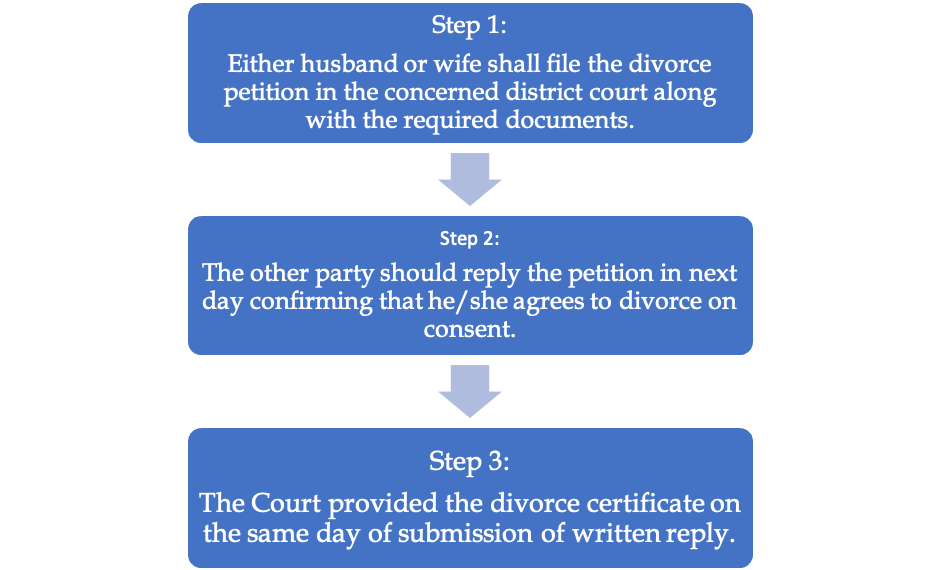
Step 1: Either the husband or wife shall file a divorce petition in the concerned District Court along with the required documents.
Step 2: The other party should reply to the petition on the next day, confirming that he/she agrees to the divorce by mutual consent.
Step 3: The Court shall issue the divorce certificate on the same day the written reply is submitted.
Timeline:
Divorce case in mutual understanding can be completed within 2 to 3 days.
04. Divorce Process in Nepal Without Consent
When only one spouse wants the divorce, the process is longer and involves several procedural stages under the NCC.
Step-by-Step Contested Divorce Procedure
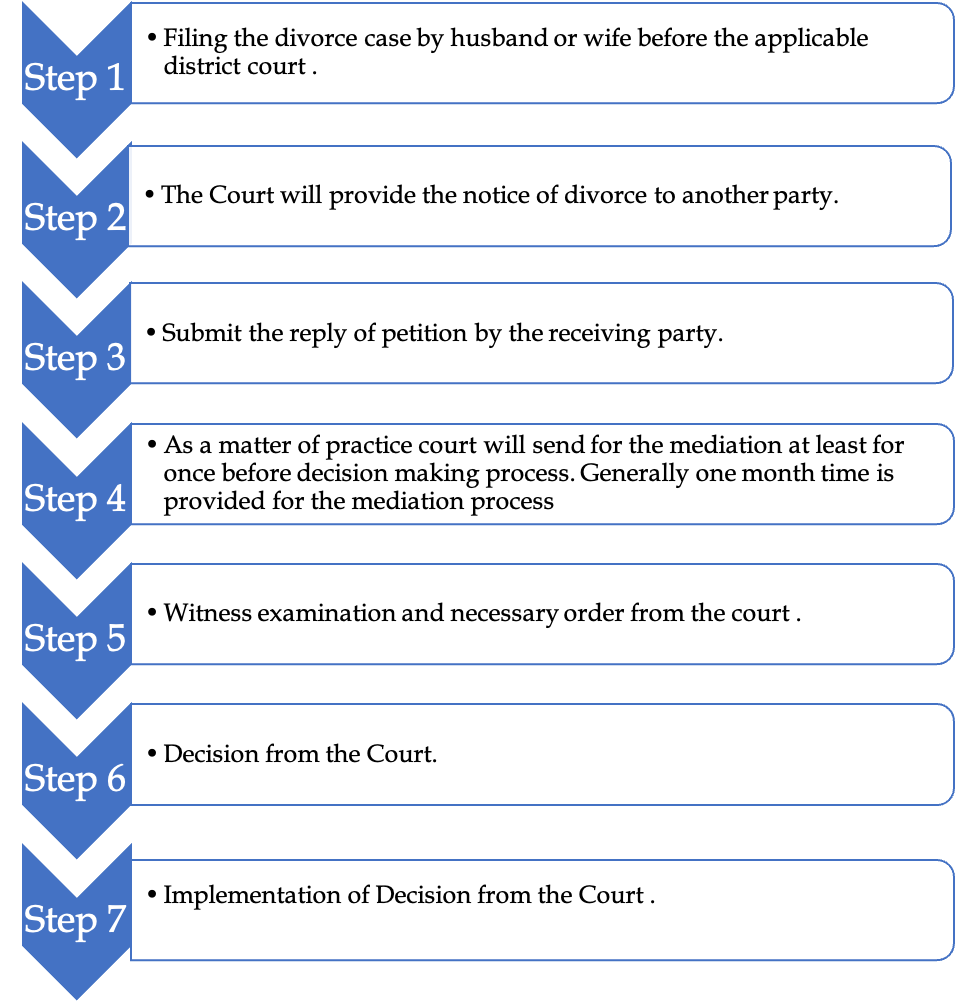
- Filing the Petition – The husband or wife files a divorce petition at the concerned District Court, stating the legal grounds for divorce.
- Notice to the Other Party – The Court issues a formal notice of the divorce case to the other spouse.
- Reply from the Receiving Party – The receiving spouse submits a written reply to the petition.
- Mediation – As a matter of practice, the Court refers both parties to mediation at least once before proceeding further. Mediation is generally allowed one month to conclude.
- Witness Examination – If mediation fails, the Court examines witnesses and issues any necessary interim orders.
- Court's Decision – The Court issues its final decision on the divorce.
- Implementation – The Court's decision is implemented, including partition of property where applicable.
Property Partition During the Process
During a contested divorce, the Court must also decide how to divide property between husband, wife, and children. A wife has the right to waive her share of the property if she chooses not to claim it.
Timeline
A contested divorce in Nepal without mutual consent generally takes 12 to 14 months, though straightforward cases may conclude closer to 9–12 months depending on the district court's caseload and whether mediation succeeds.
05. Mutual Consent vs. Without Consent — Comparison Table
Factor With Mutual Consent Without Consent Legal Basis Section 96, NCC Section 95, NCC Timeline 2–3 days 12–14 months Mediation Required No Yes (up to 1 month) Grounds Needed None (mutual agreement) Must prove specific grounds Court Visits Minimal Multiple (notice, reply, witness examination, decision)
06. Grounds for the initiation of divorce in Nepal
Divorce in Nepal without mutual consent must be based on specific grounds set out in Section 95 of the NCC. A husband may file for divorce if: Note: A husband is not liable to give property to his wife if he can prove any of the following: A wife may file for divorce if: Grounds on Which the Husband May File for Divorce
Grounds on Which the Wife May File for Divorce
SUMMARY TABLE
Ground Husband May File If... Wife May File If... Separation Spouse lived separately for 3+ consecutive years without consent Spouse lived separately for 3+ consecutive years without consent Maintenance/Expulsion Wife expels him or deprives him of maintenance Husband expels her or deprives her of maintenance Cruelty Wife commits an act or conspiracy causing grievous hurt or severe physical or mental pain Husband commits an act or conspiracy causing grievous hurt or severe physical or mental pain Infidelity Wife is proved to have had sexual relations with another man Husband is proved to have had sexual relations with another woman Bigamy — (not listed as a husband's ground in the NCC) Husband marries another woman Marital Rape — (not listed as a husband's ground in the NCC) Husband is proved to have committed marital rape against her
07. Documents required for the divorce
The following documents are required to initiate the divorce in Nepal: Document Required Applicable Cases Citizenship certificate (both spouses) Both cases Marriage registration certificate (or ritual photos/evidence) Both cases Birth certificate (under 16) or citizenship (16+) of children Both cases Passport-size photos (2 copies each spouse) Both cases Signed consent agreement Mutual consent only
08. Filing Divorce From Outside Nepal
Nepali law requires that property be partitioned equally among the husband, wife, and children upon divorce. Until the partition is completed, the wife has the right to claim alimony from her husband to cover her monthly expenses, based on his income and property. A wife may receive her share of the property either as a cash lump sum or as a share of property, or she may choose to waive her claim entirely.
09. Partition of Property During Divorce
Nepali law requires that property be partitioned equally among the husband, wife, and children upon divorce. Until the partition is completed, the wife has the right to claim alimony from her husband to cover her monthly expenses, based on his income and property.
A wife may receive her share of the property either as a cash lump sum or as a share of property, or she may choose to waive her claim entirely.
10. Custody of Children After Divorce
Both the mother and father of children can take care of the children after the divorce. Law has recognized the following for the custody of children:
| S.N. | Age | Custody with |
|---|---|---|
| 1. | Below 5 years | Custody goes to the mother, regardless of whether she remarries. |
| 2. | Above 5 years | Custody generally remains with the mother if she wishes, unless she has remarried. |
| 3. | After the Completion of 10 years | The child's own opinion on custody must be obtained by the Court. |
Note: Despite the matrimonial relationship between the husband and wife being legally terminated, the obligations of both parents toward their children continue to exist. The children's property may remain with either the father or the mother after the partition of the property.
11. Remarriage after divorce
Once a marriage is registered, it can only be dissolved through the court process described above. Once the divorce is finalized, both spouses are free to remarry.
12. Registering the Divorce Certificate
After the Court grants the divorce certificate, one of the parties must register it at the ward office where the original marriage was registered. This step formally updates the civil record and is required before either party can remarry or use the divorce certificate for other legal purposes.
13. Recognition of Nepali Divorce Certificates Abroad
A divorce certificate issued by a Nepali court is recognized internationally. If you need to use your divorce certificate/document in a foreign jurisdiction, it should be authenticated through the following steps:
- Notarization at the Department of National Personal Record (Rastriya Kitabkhana).
- Attestation from the Ministry of Foreign Affairs, Government of Nepal.
Our team at Bhandari Law & Partners handles this entire notarization and attestation process for clients who need their divorce documents recognized outside Nepal.
Date of Publication: 10 January 2023
Disclaimer: Bhandari Law and Partners is one of the leading law firm in Nepal with team of best professiona lawyers This article published on website of the law firm is just for information purpose only. It shall not be taken as the legal advice, advertisement, personal communication, solicitation or inducement. Bhandari Law and Partners or any of the team members of the firm shall not be liable for the consequence arising of the information provided. As the factual situation may be different on your case, thereof if you need further legal advice on the subject matter, please Contact Us.
Read our detailed guide on family law in Nepal
Related Professionals:
Frequently Asked Questions
1. 1. What is the process of registration of divorce in Nepal with consent?
Pursuant to Section 93 of NCC, husband and wife in their mutual understanding can get divorced at any time. The following procedures are being followed while divorce is done in mutual understanding of husband and wife:
2. 2. What will be the timeline to complete the divorce with consent ?
The divorce in mutual understanding can be completed within 2 to 3 days.
3. 3. What is the process to register the divorce in Nepal, without mutual consent?
The following procedure has to be followed for the divorce process (without mutual consent divorce):
*Note:
During the divorce process the court needs to decide on the matter of partition of property among the husband, wife and children.
Wife has right to exempt the property if she does not wish to take the property from husband.
4. 4. What are the required documents to do divorce in Nepal?
The following documents are required to initiate the divorce in Nepal:
| S.N. | Documents required |
|---|---|
| 1. | A copy of citizenship of both husband and wife |
| 2. | A copy of marriage registration certificate (if not then, photos of marriages conducted through rituals shall work) |
| 3. | A copy of birth certificate (in case of children under 16) or citizenship certificate |
| 4. | 2 copies of passport size photos of husband and wife |
5. 5. Shall it be possible for an individual living in abroad to file divorce in Nepal without his or her presence?
Yes, it is possible. A Nepali Citizen or foreign Citizen living abroad can file the divorce case in Nepal without their presence in Nepal. One need to execute Authorized Power of Attorney ("POA") and had to approve the same from the respective Nepal Embassy located at foreign country.
*Note: POA can granted either to relatives, friends, Lawyers or any person living in Nepal to initiate the case.
For quick legal assistance:
You can directly call to our legal expert: +977-9808811027
Even can call or drop a text through What’s app , Viber, Telegram and We Chat at the same number.
Also can do email on : info@lawbhandari.com
Publication
- 1. Business Visa in Nepal: Eligibility, Documents, Fees & Procedure
- 2. Termination of Employment Under Labor Law of Nepal
- 3. Registration of Non-Governmental Organizations (NGO) in Nepal
- 4. Establishment of Business in Nepal By Foreign Investors
- 5. Labor law in Nepal | Highlights of Labor Act | Latest Guide
- 6. Company Registration Process in Nepal | Latest 2026 Guide
- 7. Registration of Non-Profit Institution in Nepal
- 8. Branch Office Registration Process in Nepal
- 9. Cheque Bounce in Nepal : Applicable Legal Remedy
- 10. Procedure of Conducting Labor Audit in Nepal
- 11. Foreign Direct Investment (FDI) Approval Process in Nepal
- 12. Trademark Registration in Nepal
contact us
Get in Touch with Our Legal Experts
Have a question or need legal assistance? Fill out our contact form and our team of experienced lawyers in Kathmandu, Nepal will get back to you promptly.
Please include your WhatsApp or Viber number in the phone section if you'd prefer a direct call from one of our legal professionals.
We are here to provide trusted legal support tailored to your needs.
Consult a lawyer in Nepal
Park Lane Road, Buddhanagar-10, Kathmandu, Nepal.
Phone : +9779808811027, +9779849964619
info@lawbhandari.com, nabin@lawbhandari.comConnect with our professional lawyers in Nepal :
Follow Our Law Firm on Social Media :