Table of content
-
Setting Aside of an Arbitral Award in Nepal : Grounds, Procedure and Legal Framework
01. Introduction
Under the prevailing arbitration law of Nepal, an arbitral award is meant to be final and binding. However, the law does allow an award to be set aside on a set of grounds and within a time limit. This article explains those grounds, the procedures, the applicable laws, the principle of finality, documents required, and the differences between setting aside and refusal of enforcement.
02. Legal Framework of Setting Aside of an Arbitral Award
Section 30 of the Arbitration Act, 2055 (1999) (“Arbitration Act”) is the principal provision dealing with challenges to an arbitral award. Under Section 30(1), a party dissatisfied with an award may apply to the competent High Court to have the award set aside. The application must be filed within 35 days from the date on which the party heard the decision or received notice of the decision, together with the relevant documents and a copy of the award.
The Arbitration (Court Procedure) Rules, 2059 further prescribe the matters that must be stated in an application challenging an award. Rule 11 requires, among other matters, particulars of the applicant and respondent, details concerning the arbitrator, the subject matter submitted to arbitration, and the grounds relied upon for setting aside the award. The New York Convention 1958 also binds Nepal as a member state.
03. Principle of Finality
One of the fundamental principles in an arbitral award is that an arbitral award is final and is not subject to an ordinary appeal. This is one of the factors that differentiates an arbitral proceeding from ordinary civil proceedings. In a court proceeding, the party not satisfied with the case has a statutory right of appeal on questions of fact, law, or both. Arbitration does not operate in the same manner.
The Supreme Court, through its decisions, time and again has established the principle that the arbitration award is not subject to an appeal procedure like the regular court decisions. In Kanchanjunga Tamang Joint Venture v. Patan Appellate Court et al, NKP 2081, Decision No. 11322, the Supreme Court held that the decision of the appellate court is summary supervisory; it may not act as if it is hearing a full appeal on the merits. Likewise, in Manjit Singh vs. Kankai Irrigation Project, Department of Irrigation, et al. NKP 2067, D.N: 8397. The Supreme Court held that courts do not possess ordinary appellate jurisdiction in arbitration matters.
04. Grounds for Setting Aside of Arbitral Award in Nepal
For an arbitral award to be enforced in Nepal, the following grounds should be satisfied:
A. Grounds the applicant must prove under Section 30(2)
| S. N. | Grounds |
|---|---|
| 1. | Any party to the agreement was incapable of entering into the agreement at the time of its conclusion for any reason, or the agreement was not valid under the law of the country to which the parties were subject or, where that law was not clear, under Nepalese law. |
| 2. | The applicant was not given due notice, in time, of the appointment of the arbitrator or of the arbitral proceedings. |
| 3. | The decision was made on a matter not submitted to the arbitrator, contrary to the terms submitted to the arbitrator, or beyond the scope of the matter submitted to the arbitrator. |
| 4. | Except where the agreement is contrary to Nepalese law, the constitution of the arbitral tribunal or its proceedings did not comply with the agreement between the parties, or, where there was no such agreement, did not comply with this Act. |
B. Grounds the court can apply on its own under Section 30(3)
| S. N. | Grounds |
|---|---|
| 1. | If the dispute decided by the arbitrator is of a nature that cannot be settled by arbitration under Nepalese law. |
| 2. | If the decision made by the arbitrator is contrary to public policy. |
Along with statutory grounds In Kanchanjunga Tamang Joint Venture v. Patan Appellate Court et al., NKP 2081 Decision No. 11322, the Supreme Court set various grounds for setting aside an award such as:
- The decision is biased/partial
- It violates prevailing law and established legal norms
- There is a direct/patent error of law
- The decision is unclear, meaningless, or defective
- It contradicts a term specified in the agreement between the parties
- The decision adopts a wrong legal principle
05. Time Limit
An application to set aside an arbitral award must be filed with the High Court within 35 days from the date of receiving or being heard the award under Section 30(1) of the Arbitration Act. If the applicant misses this deadline, the award becomes final and can no longer be challenged.
06. Scope of Judicial Review
Courts can only decide to set aside the award following the statutory grounds as mentioned in Section 30(2) (3) and cannot reconsider the merits of the case. This restraint was reinforced by an arbitration ordinance the Government of Nepal promulgated on 13 January 2025, later consolidated through the Act to Amend Some Nepal Acts Relating to Improving Economic and Business Environment and Enhancing Investment, 2081 (2025), which took effect on 18 Chaitra 2081(31 March 2025).
Among other changes, these reforms expressly bar the re-examination of evidence in set-aside proceedings, confining the High Court strictly to questions of procedure and jurisdiction rather than permitting a de novo evaluation of the facts.
07. Procedures of Setting Side of Arbitral Award in Nepal
The process of setting aside an arbitral award in Nepal is as follows:
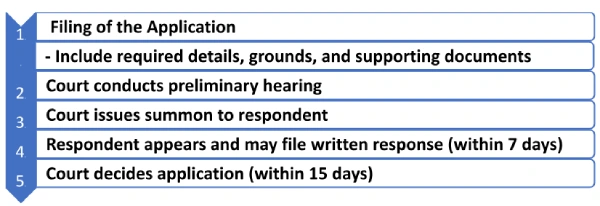
Step 1: Filing of the Application
An application against the decision of an arbitrator shall be filed before the High Court under Section 30(1) of the Arbitration Act, 2055 (1999) within 35 days from the date of receiving or being heard the award.
Required Documents and Particulars
As per Rule 11(1) of the Arbitration (Court Procedure) Rules, 2059 the following documents are required to be submitted along with the application:
-
The name, surname, and address of the applicant and the respondent, including the address of the place of business/transaction and any other details necessary to serve notice.
-
The name, surname, and address of the arbitrator, and the location of the arbitrator's office.
-
The subject matter referred to the arbitrator for decision.
-
A brief description of the arbitrator's decision.
-
A statement of whether the arbitrator's decision is to be set aside, or a re-decision is sought.
-
The specific ground under Section 30(2) of the Act on which the decision is to be set aside or re-decided, along with the basis and evidence supporting it.
-
A confirmation that a copy of the application has been provided to the arbitrator and the concerned party, as required under Section 30(1).
-
The following documents shall be attached to the application:
-
an attested copy of the arbitrator’s decision;
-
copies of any other relevant orders or documents; and
-
a copy of the arbitration agreement.
Step 2: Preliminary Hearing and Issuance of Summons
Upon preliminary hearing, if the Court is satisfied that the claim made in the application appears capable of being established, it shall call for the relevant case file and issue a summons directing the respondent to appear before the Court.
Step 3: Court issues summon to respondent
Step 4: Appearance and Written Response
The respondent shall be given seven days to appear before the Court. Within this period, the respondent may, if they so wish, submit a written response to the application.
Step 5: Decision by the Court
The Court ordinarily decide the application within fifteen days from the date of the respondent's appearance, or of the expiry of the period given for appearance. The Court shall inform both the arbitrator and any absent party of its decision.
08. Finality of the decision of Court and Further Recourse
A decision of the High Court on a set-aside application is final and binding, and the Act provides no statutory right of appeal against it. In rare cases, however, parties have challenged such decisions, and the underlying award itself, through an extraordinary writ petition to the Supreme Court, typically on the footing that all ordinary remedies have been exhausted and that the decision reflects a gross error of law. In Yakshyadhoj Karki v. High Court., Patan, NKP 2076, Decision No. 10369, the case which came in the Supreme Court through extraordinary jurisdiction, in this case the Court has held that a party who declines to participate in arbitral proceedings despite having received notice cannot later rely on lack of notice as a ground to set aside the resulting award.
09. Setting Aside of Arbitration Award Vs. Refusal of Enforcement of Foreign Award
Setting aside and refusal of enforcement are two distinct methods of challenging the effect of an arbitral award. Setting aside means asking a competent court to annul or cancel the award itself on the ground that there is a legal defect in the arbitration process or in the award. Such an application is ordinarily made before the court of the seat of arbitration, because the courts at the seat have supervisory jurisdiction over the arbitral proceedings. If the award is set aside by the competent court at the seat, its legal effect may be affected beyond that jurisdiction, subject to the applicable law and the rules governing recognition of arbitral awards.
Refusal of enforcement, on the other hand, does not seek to annul or cancel the award. It means asking the court of the country where enforcement is sought not to recognize or enforce the award on one or more legally recognized grounds. The award may continue to exist as a valid arbitral award, even if its enforcement is refused in a particular jurisdiction. Therefore, the fundamental distinction is that setting aside concerns the validity or continued existence of the award itself, whereas refusal of enforcement concerns whether that award can be recognized and enforced in a particular jurisdiction.
| Setting Aside of an Arbitral Award | Refusal of Enforcement of an Arbitral Award |
|---|---|
| It challenges the validity of the award itself. | It challenges only the enforceability of the award, not its validity. |
| It cancels/annuls the award. | The award remains valid, but its execution is blocked or refused. |
| Can happen only in the court of law of the seat. | Can arise in any country where enforcement is sought, either domestic or foreign. |
| Governed by Section 30, Arbitration Act, 2055. | Governed by Section 34(4) for foreign awards; Section 32(3) allows a stay of execution even for a domestic award. |
| It is an active challenge to overturn the award. | It is a defensive step taken only when execution is sought. |
10. Judicial Approach on Setting Aside of Arbitral Award
Kanchenjunga Tamang Joint Venture v. Patan Appellate Court et al., Decision No. 11322, NKP 2081
It was held that beyond the specific grounds listed in the law, an arbitral award can also be set aside where the arbitrator's decision was biased, contrary to prevailing law or established legal principles, or contained a direct legal error. An award may likewise be set aside if it is unclear, meaningless, or flawed in its reasoning, if it violates any term of the agreement between the parties, or if it was reached by applying a wrong legal principle.
This broadens the scope for judicial intervention beyond the closed list of grounds written in the statute, allowing courts additional flexibility to act where an arbitrator's decision is fundamentally defective, even if that defect does not neatly fit within the enumerated statutory categories.
Nepal Airlines Corporation v. Patan Appellate Court et al., Decision No. 8523, NKP 2067
A party who was not given notice, or never actually received notice, of the arbitration proceedings may apply to set aside the arbitrator's decision under Section 30(1); but where proper notice was given or credibly shown to have been received, that ground is unavailable. A dispute arising from and connected to the underlying agreement, such as expenses from a dishonored cheque, falls within the arbitrator's jurisdiction under that agreement.
Date: 31 August 2026
Related Professionals:
For quick legal assistance:
You can directly call to our legal expert: +977-9808811027
Even can call or drop a text through What’s app , Viber, Telegram and We Chat at the same number.
Also can do email on : info@lawbhandari.com
Publication
- 1. Labor law in Nepal | Highlights of Labor Act | Latest Guide
- 2. Registration of Non-Governmental Organizations (NGO) in Nepal
- 3. Registration of Company Not Distributing Profits in Nepal
- 4. Cheque Bounce in Nepal : Applicable Legal Remedy
- 5. Establishment of Business in Nepal By Foreign Investors
- 6. Foreign Direct Investment (FDI) Approval Process in Nepal
- 7. Branch Office Registration Process in Nepal
- 8. Liaison Office Registration Process in Nepal
- 9. Company Registration Process in Nepal | Latest 2026 Guide
- 10. Termination of Employment Under Labor Law of Nepal
- 11. Registration of Non-Profit Institution in Nepal
- 12. Trademark Registration in Nepal
contact us
Get in Touch with Our Legal Experts
Have a question or need legal assistance? Fill out our contact form and our team of experienced lawyers in Kathmandu, Nepal will get back to you promptly.
Please include your WhatsApp or Viber number in the phone section if you'd prefer a direct call from one of our legal professionals.
We are here to provide trusted legal support tailored to your needs.
Consult a lawyer in Nepal
Park Lane Road, Buddhanagar-10, Kathmandu, Nepal.
Phone : +9779808811027, +9779849964619
info@lawbhandari.com, nabin@lawbhandari.comConnect with our professional lawyers in Nepal :
Follow Our Law Firm on Social Media :