Table of content
-
Foreign Employment Cases in Nepal : Legal Framework, Investigation Process and Punishment
01. Foreign employment cases in Nepal- Background information
Foreign employment has become a vital source of livelihood for many Nepalese citizens and a major contributor to the national economy through remittances. Due to limited employment opportunities within the country, a significant number of Nepalese workers migrate abroad each year searching for better economic prospects, particularly to Gulf countries and other labor-receiving nations.
Despite its economic significance, the foreign employment sector has increasingly become vulnerable to fraud and exploitation. Many aspiring migrant workers fall victim to deceptive recruitment practices, including false promises of employment, excessive recruitment fees, forged documents, human trafficking, and unauthorized overseas placements. These offenses often result in financial loss, labor exploitation, and serious violations of migrant workers's rights.
This article examines the legal framework governing foreign employment offenses in Nepal, the authorities responsible for enforcement, the investigation and prosecution process, the applicable punishments and compensation provisions, and recent trends in the sector.
02. Governing Laws of Foreign Employment in Nepal
Foreign employment in Nepal is primarily governed by the Foreign Employment Act, 2007 (2064). The Act serves as the principal legislation regulating foreign employment recruitment, licensing of manpower companies, worker protection, investigation, adjudication, and punishment of offences.
Among others, the following are the major laws governing foreign employment-related offenses in Nepal:
| S.N. | Act | Details |
|---|---|---|
| 2 | Foreign Employment Act, 2007 (2064) | Regulates recruitment agencies, overseas employment procedures, migrant workers' rights, and prescribes offences, investigation procedures, punishments, and compensation for victims. |
| 3 | Foreign Employment Rules, 2008 (2064) | Prescribes detailed procedures relating to licensing of recruitment agencies, labor permits, documentation, recruitment processes, and other administrative requirements for the effective implementation of the Act. |
| 4 | Human Trafficking and Transportation (Control) Act, 2007 (2064) | Applies where foreign employment involves trafficking, forced labor, deception, or forces victims into exploitative conditions akin to slavery. |
| 5 | Muluki Criminal Code, 2017 (2074) | Provides general provisions relating to cheating, forgery, fraud, and organized crime. |
| 6 | Organized Crime (Prevention and Control) Act, 2013 (2070) | Invoked where foreign employment offenses are committed by an organized criminal group or involve coordinated criminal activities. |
03. Governing Authorities
Several government bodies play distinct roles in regulating foreign employment and enforcing the legal framework against foreign employment offenses in Nepal. Major governing authorities are as follows:
-
Ministry of Labor, Employment and Social Security (MoLESS)
The Ministry of Labor, Employment and Social Security is the apex authority responsible for formulating policies, laws, and regulations relating to foreign employment. It oversees the implementation of the Foreign Employment Act and supervises agencies involved in labor migration.
-
Department of Foreign Employment (DoFE)
The Department of Foreign Employment is the primary regulatory authority responsible for monitoring foreign employment activities and enforcing the provisions of the Foreign Employment Act. Its main functions include:
-
Registration and regulation of recruitment agencies.
-
Monitoring compliance with foreign employment laws.
-
Receiving complaints from migrant workers.
-
Conducting investigations into foreign employment offences.
-
Recommending prosecution of offenders.
-
Foreign Employment Tribunal
The Foreign Employment Tribunal is a specialized three-member quasi-judicial body dedicated to adjudicating criminal cases initiated under the Foreign Employment Act. It is established under the Foreign Employment Act. It has jurisdiction to impose punishment, order compensation to victims, and adjudicate cases filed under the Act.
-
Nepal Police
Nepal Police assist in the investigation of foreign employment offenses, particularly where cases involve fraud, organized crime, human trafficking, forged documents, or other criminal activities requiring police intervention. Nepal Police may conduct parallel investigations under applicable criminal laws. Specially, District Police Offices & Human Trafficking Investigation Bureau collaborates on criminal investigations, executing arrest warrants, and pursuing offenses involving personal fraud or overlapping human trafficking elements.
-
Foreign Employment Board
The Foreign Employment Board is responsible for promoting the welfare of migrant workers and their families. It provides financial assistance, rescue and repatriation support, compensation, insurance-related facilitation, and rehabilitation services in accordance with the Foreign Employment Act.
04. Obligation of Foreign Employment Businesses in Nepal
The Foreign Employment Act imposes several legal obligations on licensed foreign employment businesses (manpower companies) to ensure that Nepali workers are recruited and deployed in a lawful, transparent, and safe manner. These obligations are intended to protect migrant workers from fraud, exploitation, and other forms of abuse while promoting ethical recruitment practices. They are briefly pointed as below:
-
Obtain a Valid License: Foreign employment businesses must obtain and maintain a valid license from the Department of Foreign Employment (DOFE) and comply with all licensing conditions.
-
Recruit Through Approved Demand: Workers may only be recruited after obtaining approval of the labor demand from the DOFE and for government-approved destination countries.
-
Provide Genuine Employment: Ensure that the foreign employer, job, salary, and working conditions are genuine and consistent with the approved demand.
-
Execute Written Employment Contracts: Enter into a written employment contract with each worker specifying wages, job description, working hours, benefits, leave, accommodation, and other terms.
-
Charge Only Prescribed Fees: Collect only the government-approved service charges and issue official receipts for all payments.
-
Provide Accurate Information: Disclose truthful information regarding the employer, job nature, salary, workplace, and employment conditions without misleading workers.
-
Complete Pre-departure Formalities: Arrange mandatory insurance, medical examination, orientation training, labor approval, and other legal requirements before departure.
-
Maintain Records: Keep proper records of workers, contracts, payments, and recruitment documents and produce them before authorities when required.
-
Protect Workers' Rights: Refrain from contract substitution, illegal deployment, overcharging, or sending workers to unauthorized jobs or destinations.
-
Cooperate with Authorities: Comply with directions of the DOFE, facilitate inspections, assist in investigations, and support worker repatriation where required.
05. Key Offences and Punishment for Foreign Employment Offence
Under Chapter 9 of the Foreign Employment Act, 2064 (2007), offenses are structured around whether they are committed by licensed entities (manpower companies) or unlicensed individuals/agents. The primary criminal and administrative offenses under the Act along with their corresponding sections include:
| Section | Offence | Punishment |
|---|---|---|
| 43 | Operating foreign employment business without a license or collecting money by giving false promises of foreign employment. | 3 to 7 years imprisonment + Fine NPR 3,00,000 to 5,00,000 + Compensation |
| 44 | Sending workers abroad without labor approval from DoFE. | 3 to 7 years imprisonment + Fine NPR 3,00,000 to 5,00,000 |
| 45 | Sending a minor (below 18 years) for foreign employment. | 3 to 7 years imprisonment + Fine NPR 3,00,000 to 5,00,000 |
| 46 | Sending workers to prohibited countries or through false visas. | 3 to 5 years imprisonment + Fine NPR 3,00,000 to 7,00,000 + Compensation to the victim |
| 47 | Forging or falsifying documents. | 6 months to 1 year imprisonment + Fine NPR 1,00,000 to 3,00,000 |
The Act also provides punishment for several other violations, including Non-Payment of Prescribed Remuneration (Section 51), charging recruitment fees in excess of the amount prescribed by the Government (Section 53), sending workers on terms and conditions different from those approved by the Department (Section 55) and other breaches of statutory duties imposed on recruitment agencies. Depending on the nature of the violation, offenders may be subject to imprisonment, fines, compensation, suspension or cancellation of licenses, and other administrative sanctions under the Act.
06. Filing complaint, Investigation and Prosecution Process of Foreign Employment Cases
6.1. Filing of Complaint
-
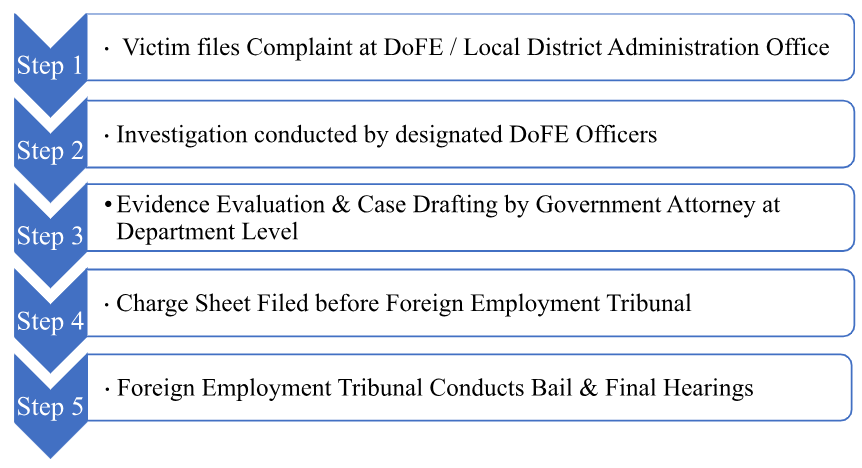
A victim, family member, representative, or other concerned person may file a complaint regarding any offence under the Act before the Department of Foreign Employment. complaints may also be submitted through postal or electronic means. In addition, a complaint that falls within the jurisdiction of the Department may also be filed before the Chief District Officer (CDO) of the concerned district, who is required to forward it for necessary action
-
For most offences, the complaint must be filed within one year from the date of the offence. However, in the case of a worker who has gone abroad for foreign employment, the limitation period is one year from the date of his or her return to Nepal. This limitation does not apply to offences punishable under Sections 43, 44, 45, 46, and 47 of the Act.
6.2. Investigation
Foreign employment department acts as the primary investigating body for the offences relating to foreign employment. Upon receiving a complaint, the Department examines whether a prima facie offence exists under the Foreign Employment Act or not. If the offence has occurred as per the act, then the investigation process is commenced. The major investigation process are as follows:
-
Where the Department receives a complaint or otherwise obtains information that an offence has been or is likely to be committed under the Act, it may designate an officer of at least Gazetted Third Class as an Investigating Officer.
-
The Investigating Officer has powers similar to those of the police under the prevailing law, including the power to arrest suspects, conduct searches and seizures, seize documents and other evidence, record statements, and prepare investigation reports.
-
If sufficient grounds exist, the accused may be released on bail or guarantee, or detained with the permission of the adjudicating authority for investigation, subject to the statutory time limits.
-
Where there are reasonable grounds to believe that a person has committed an offense under Section 43 (operating foreign employment business without a license) and there is a likelihood of absconding, the police may arrest the person without a warrant. The arrested person must be produced before the competent authority within 24 hours, excluding the time required for the journey.
-
The investigation officer must obtain the opinion of the Government Attorney before filing the case, and all concerned authorities, including Nepal Police, are legally required to assist in the investigation.
-
During the investigation, the department may also suspend the license of a recruitment agency for up to six months when sufficient grounds exist.
6.3. Prosecution
Upon completion of the investigation, if sufficient evidence exists, the case is instituted in the name of the Government of Nepal, which acts as the plaintiff in all criminal proceedings under the Act (Section 63). Except for matters where the department itself is empowered to impose administrative penalties, offences under the Act are prosecuted before the Foreign Employment Tribunal, a special tribunal established under Section 64.
The Tribunal functions as a specialized court with exclusive jurisdiction over many foreign employment offences. The Tribunal conducts hearings, examines evidence, hears witnesses, and determines whether the accused has committed the alleged offence. It may:
-
Convict the accused.
-
Acquit the accused.
-
Order compensation to victims.
-
Impose fines and imprisonment.
-
Order recovery of illegally collected amounts.
Summary of complaint filing, investigation and prosecution process are:
07. Appeal Mechanism
The Foreign Employment Act, 2064, Section 66 provides an appellate mechanism against decisions made under the Act.
-
Appeal against the Department's decision: Under Section 66 (1), any person aggrieved by a decision of the Department of Foreign Employment may file an appeal before the Government of Nepal within 35 days from the date of the decision.
-
Appeal against the Tribunal's decision: Under Section 66 (2), any party dissatisfied with the judgment of the Foreign Employment Tribunal may file an appeal before the Supreme Court within 35 days from the date of the decision.
The appellate court may affirm, modify, or reverse the decision of the Tribunal based on the facts, evidence, and applicable law. The right of appeal ensures judicial oversight of decisions made under the Foreign Employment Act and safeguards the right to a fair hearing and due process.
08. Recent Trends
The landscape of foreign employment administration in Nepal is undergoing critical statutory shifts and there has been many legislative developments, enforcement practices, and emerging forms of foreign employment offences. The recent trends in Foreign Employment sector of Nepal are as follows:
-
Increase in Foreign Employment Fraud: Nepal has witnessed a growing number of complaints involving fraudulent recruitment, unauthorized agents, excessive fee collection, forged documents, and deceptive job offer through social media and digital platforms.
-
Increased Enforcement: DoFE has intensified enforcement by issuing arrest warrants, increasing inspections and fining hundreds of companies, taking action against unauthorized intermediaries, and suspending the license renewal of recruitment agencies with unresolved complaints or legal liabilities. Stricter infrastructure standards for manpower agencies, mandatory job postings via the digital Shram Sansar portal etc.
-
Technological Reforms: Expanded digital services including online labor permit processing, digitization of decades-old fraud case files, development of a digital case-tracking system to improve transparency and expedite investigations, automated re-employment permits etc.
-
Policy Push: Proposed amendments emphasize stricter licensing, electronic systems, immediate compensation, and worker-friendly provisions, strengthens victim protection, improve complaint handling, and enhance regulation of recruitment agencies.
-
Greater Protection of Migrant Workers: Recent policy measures require recruitment agencies to regularly monitor the welfare and working conditions of Nepali workers abroad, strengthen pre-departure orientation, and facilitate timely rescue and compensation where necessary.
09. Conclusion
The Foreign Employment Act, 2064 establishes a comprehensive legal framework for protecting migrant workers and regulating recruitment activities in Nepal. The Department of Foreign Employment possesses broad investigative powers to examine complaints, gather evidence, and initiate prosecution against offenders. Cases are adjudicated by the Foreign Employment Tribunal, which has authority to impose imprisonment, fines, compensation, and restitution.
While Nepal has these legal frameworks to regulate foreign employment, implementation gaps, delays in justice, and evolving fraud tactics remain key issues. For sustainable improvement, enhanced inter-agency coordination, public awareness campaigns, stricter monitoring of manpower agencies and faster judicial processes are essential.
Date of Publication: 23 July 2026
Disclaimer: This article published on website is just for information purpose only. It shall not be taken as the legal advice, advertisement, personal communication, solicitation or inducement. Bhandari Law and Partners or any of the team members of the firm shall not be liable for the consequence arising of the information provided. As the factual situation may be different on your case, thereof if you need further legal advice on the subject matter, please Contact Us.
Related Professionals:
For quick legal assistance:
You can directly call to our legal expert: +977-9808811027
Even can call or drop a text through What’s app , Viber, Telegram and We Chat at the same number.
Also can do email on : info@lawbhandari.com
Publication
- 1. Labor law in Nepal | Highlights of Labor Act | Latest Guide
- 2. Registration of Non-Governmental Organizations (NGO) in Nepal
- 3. Registration of Company Not Distributing Profits in Nepal
- 4. Cheque Bounce in Nepal : Applicable Legal Remedy
- 5. Establishment of Business in Nepal By Foreign Investors
- 6. Foreign Direct Investment (FDI) Approval Process in Nepal
- 7. Branch Office Registration Process in Nepal
- 8. Liaison Office Registration Process in Nepal
- 9. Company Registration Process in Nepal | Latest 2026 Guide
- 10. Termination of Employment Under Labor Law of Nepal
- 11. Registration of Non-Profit Institution in Nepal
- 12. Trademark Registration in Nepal
contact us
Get in Touch with Our Legal Experts
Have a question or need legal assistance? Fill out our contact form and our team of experienced lawyers in Kathmandu, Nepal will get back to you promptly.
Please include your WhatsApp or Viber number in the phone section if you'd prefer a direct call from one of our legal professionals.
We are here to provide trusted legal support tailored to your needs.
Consult a lawyer in Nepal
Park Lane Road, Buddhanagar-10, Kathmandu, Nepal.
Phone : +9779808811027, +9779849964619
info@lawbhandari.com, nabin@lawbhandari.comConnect with our professional lawyers in Nepal :
Follow Our Law Firm on Social Media :