Table of content
-
Anti-Money Laundering Law and Case Prosecution Process in Nepal
01. Concept of the Offence of Money Laundering
Money laundering is the process of disguising the proceeds of crime, so that they appear to have originated from a legitimate source. It involves the process of concealment of money obtained from illegal means, through the engagement of complex financial transactions whereby the illicit money gets placed in the country’s national financial system.
Money laundering is an independent offence that presupposes the existence of proceeds that are generated from a predicate offence. However, it is not necessary for the predicate offence to have resulted in conviction, for the initiation of the case of money laundering.
For instance, a public official receives a large bribe in exchange for awarding a government contract. To avoid detection, the official deposits the money into different bank accounts, purchases property in the names of family members, or invests in businesses to make the funds appear legitimate. This process of concealing the illegal origin of the money constitutes money laundering. In this example, corruption (bribery) is the predicate offence, while the bribe money represents the proceeds of crime that are being laundered.
02. Stages of Money Laundering
The process of money laundering generally occurs in three stages;
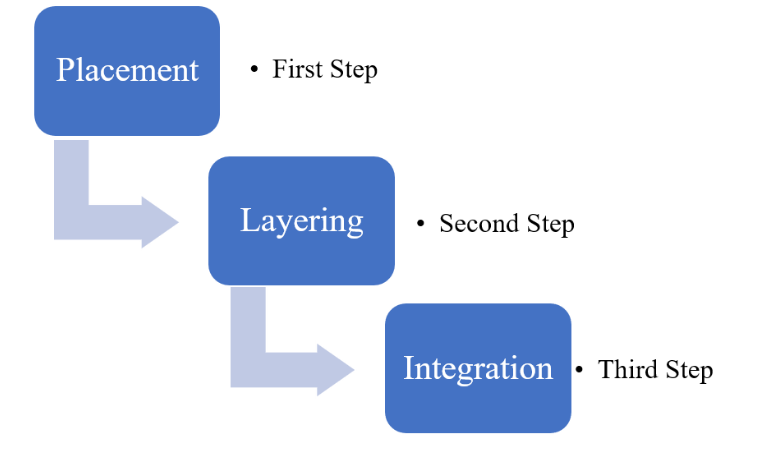
Stage 01: Placement:
The first stage is placement, where the illicit money is introduced into the financial system. Using the example above, a public official who has received a bribe may deposit the money into different bank accounts, split the cash into smaller deposits, or use the accounts of family members or associates to avoid attracting suspicion. The main objective at this stage is to introduce the illegal funds into the financial system without detection.
Layering: The second stage is layering, which involves carrying out a series of complex financial transactions to conceal the true source of the illicit funds. In this stage, the official may transfer the money through multiple bank accounts, invest it in shell companies or other businesses, or use third parties to disguise the origin of the funds. These transactions are intended to create distance between the criminal activity (corruption) and the proceeds of crime.
Stage 02: Layering:
The second stage is layering, which involves carrying out a series of complex financial transactions to conceal the true source of the illicit funds. In this stage, the official may transfer the money through multiple bank accounts, invest it in shell companies or other businesses, or use third parties to disguise the origin of the funds. These transactions are intended to create distance between the criminal activity (corruption) and the proceeds of crime.
Stage 03: Integration:
The final stage is integration, where the laundered money is reintroduced into the economy as apparently legitimate wealth. At this stage, the official may use the funds to purchase real estate, invest in lawful businesses, buy luxury vehicles or other high-value assets, or finance other investments. Once integrated, the money can be used with a significantly reduced likelihood of raising suspicion regarding its illegal origin.
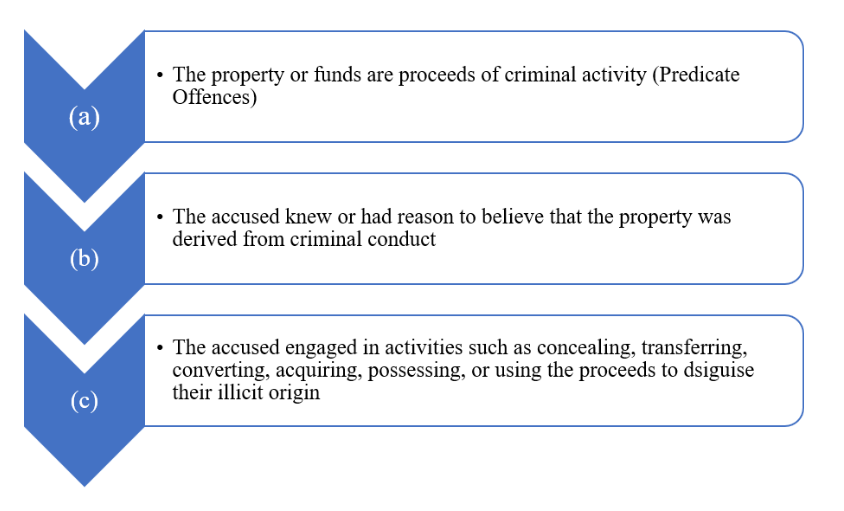
03. Essential Elements of the Money Laundering
For an act to be established as an offence of money laundering, the authorities must generally prove the following:
04 Historical Background of Anti-Money Laundering Laws
The concept of anti-money laundering (“AML”) emerged as an international response to the increasing threats posed by organized crime, drug trafficking, corruption, and other profit-driven criminal activities. The modern AML framework began to take shape with the adoption of the United Nations Convention against Illicit Traffic in Narcotic Drugs and Psychotropic Substances, 1988 (Vienna Convention), which required States to criminalize money laundering.
The establishment of the Financial Action Task Force (FATF) in 1989 further strengthened global efforts by introducing the Forty Recommendations, which have become the international standard for combating money laundering and terrorist financing. Subsequent international instruments, including the United Nations Convention against Transnational Organized Crime, 2000 and the United Nations Convention against Corruption, 2003, expanded international cooperation in preventing financial crimes and recovering illicit assets.
Nepal's anti-money laundering framework developed in line with these international standards and commitments. Before 2008, offences involving illicit assets were addressed through various criminal laws, but there was no comprehensive legislation specifically targeting money laundering. To fulfill its international obligations and strengthen the integrity of its financial system, Nepal enacted the Asset (Money) Laundering Prevention Act, 2008 (2064 B.S.), which criminalized money laundering, established procedures for tracing and confiscating proceeds of crime, and imposed preventive obligations on financial institutions and other reporting entities.
Since the enactment of the AML law, Nepal has continuously strengthened its legal and institutional framework through legislative amendments, regulatory measures, and enhanced enforcement. The establishment of the Financial Information Unit (FIU-Nepal) under Nepal Rastra Bank and the Department of Money Laundering Investigation (DMLI) has improved the country's ability to detect, investigate, and prosecute money laundering offences. As a member of the Asia/Pacific Group on Money Laundering (APG), Nepal continues to align its AML regime with the evolving recommendations of the FATF and international best practices to combat financial crime effectively.
05. Legal Framework Governing Money Laundering in Nepal
The primary laws governing Money Laundering in Nepal are as follows:
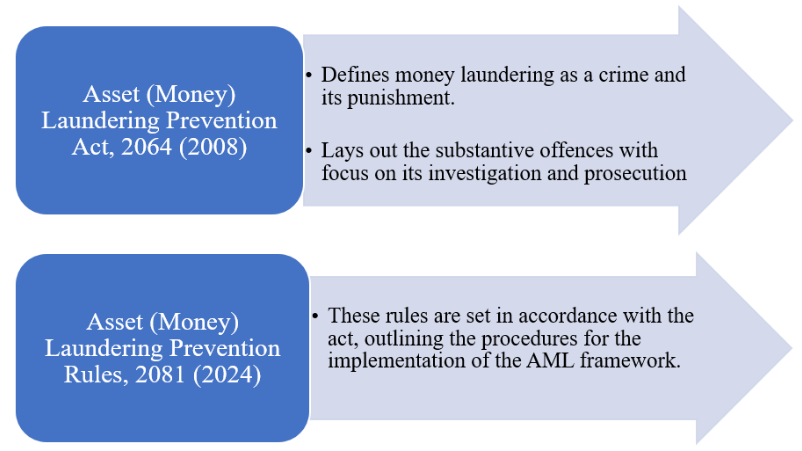
In addition to this, there are numerous other acts in force that interact with the enforcement and compliance with the AML framework in Nepal. This includes: Income Tax Act, 2002 (2058); Prevention of Corruption Act, 2002 (2059) among others. These legislative mechanisms form part of a broader framework to establish the substantive and procedural AML framework.
06. Reporting Entities
In order to detect money laundering, the following entities play a crucial role. For the preliminary identification of money laundering, these entities are part of the first line of defense to make timely detection of illicit fund transfers, deposits and use.
The following entities have been listed as Reporting Entities, with a legal duty to report suspicious activities :
| S.N. | Category of the Reporting Entities | Number of the Entities |
|---|---|---|
| 1 | Commercial Banks | 20 |
| 2 | Development Banks | 17 |
| 3 | Finance Companies | 17 |
| 4 | Micro-Finance Institutions | 52 |
| 5 | Infrastructure Development Bank | 1 |
| 6 | Co-operative Bank | 1 |
| 7 | Employee Provident Fund | 1 |
| 8 | Social Security Fund | 1 |
| 9 | Citizen Investment Fund | 1 |
| 10 | HIDCL | 1 |
| 11 | Payment Service Providers | 23 |
| 12 | Payment System Operators | 9 |
| 13 | Hire Purchase Loan Providing Companies | 10 |
| 14 | Remittance Companies | 24 |
| 15 | Money Changers | 304 |
| 16 | Others | 2310 |
Role and Obligations of the Reporting Entities
-
Know Your Customer (KYC) Obligations: KYC involves the process of identifying and verifying the identity of the customers, to ensure that there is no unlawful activity on their part. It requires the customers to provide detailed information about themselves, their source of funds and other details as required.
-
Suspicious Transaction Reporting (STR): Suspicious Transaction Reporting is done when a transaction involves proceeds of crime or appears suspicious. Upon such suspicion, the Reporting Entities are required to provide such information to the FIU.
-
Threshold Transaction Reporting (TTR): Threshold Transaction Reporting is done when a transaction crosses the established threshold, regardless of whether or not it may be suspicious. Such reporting must also be made to the FIU by the Reporting Entities.
-
Customer Due Diligence (CDD): This involves the process of assessment of the risks that may be associated with a customer. It includes evaluation into the customer’s identity, transaction trend and patterns along with risk-based profiling, which may be low, medium and high based on various factors.
-
Enhanced Customer Due Diligence (ECDD): Enhanced Customer Due Diligence requires a greater level of scrutiny into the actions of a customer. When there is an increased risk of money laundering, Reporting Entities must ensure compliance with ECDD obligations.
07. Governing Authority Regulating the Anti Money Laundering
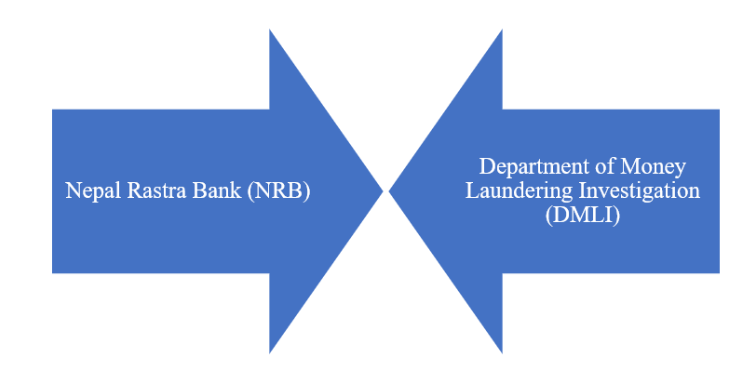
7.1. Nepal Rastra Bank
Nepal Rastra Bank (NRB) is the central bank in Nepal, responsible for the regulation and supervision of the financial institutions in the country. As the central bank, NRB oversees all financial activities to identify financial irregularities and uproot them from the domestic financial system. This also includes the prevention and eradication of money laundering. Owing to such duties and responsibilities, NRB has established two agencies that play distinct roles in the enforcement of the country’s AML/CFT/PF frameworks.
7.1.1 Financial Intelligence Unit (FIU):
The FIU acts as an intermediary between the Reporting Entities and the Law Enforcement Agencies in Nepal. The unit obtains information about any Suspicious Transactions or activities, conducts an analysis of the information and thereby, forwards the relevant information to the Law Enforcement Agencies for further investigation and regulation. The FIU is concerned with intelligence gathering and its dissemination.
7.1.2 Money Laundering Prevention Supervision Division (MLPSD):
The MLPSD is responsible for the enforcement of the laws, policies and directives in relation to AML efforts, ensuring that licensed institutions are complying with their obligations, along with the efforts to take sanction actions related to AML/CFT.
7.2. Department of Money Laundering Investigation
The Department of Money Laundering Investigation (DMLI) is one of the central institutions in the country’s AML/CFT/PF framework. It conducts preliminary or in-depth investigation into the information received through FIU or Nepal Police as required. DMLI maintains co-ordination and co-operation with different agencies, bodies and stakeholders to ensure the compliance with the country’s AML/CFT/TF framework.
DMLI is centered on detection and prosecution of money laundering. They make due utilization of various intelligence mechanisms for the investigation into the offence. It has been granted due powers such as asset freezing, initiation for prosecution and coordination with other agencies involved.
08. Money Laundering Case Investigation Process in Nepal
The entire process of money laundering investigation and prosecution in Nepal can be completed through the following steps:
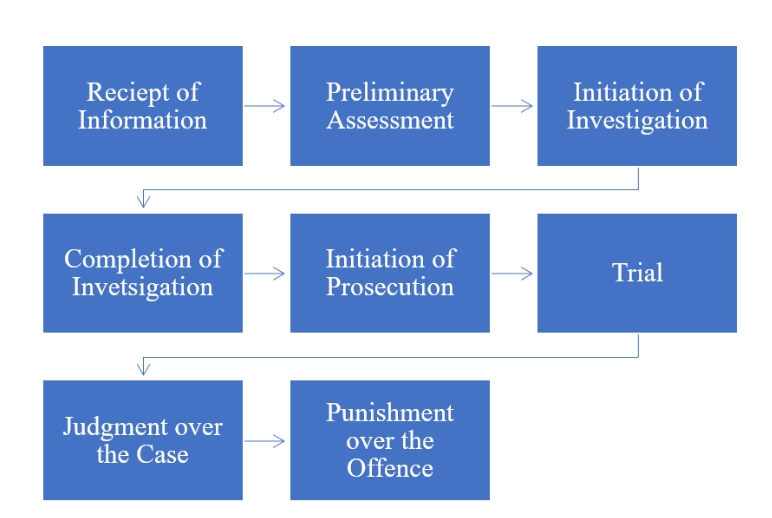
8.1. Receipt of Information
The investigation into the alleged offence of money laundering may begin through the receipt of information from the following bodies:
-
Suspicious Transaction Reports from reporting entities
-
Intelligence from the FIU
-
Complaints from individuals
-
Information from other government agencies
-
International cooperation requests
-
Media reports
-
Ongoing criminal investigations
8.2. Preliminary Assessment
Upon receipt of the complaint, Investigators conduct an initial assessment to determine:
-
Whether a predicate offence exists,
-
Whether the property may constitute proceeds of crime,
-
Whether sufficient grounds exist to initiate a formal investigation.
8.3. Initiation of Investigation
If reasonable grounds exist, the Department of Money Laundering Investigation formally registers the case and assigns investigators.
Investigators gather evidence through the examination of bank records, review of company records, analysis of financial transactions, tax records, collection of property ownership documents, search and seizure procedures and request for information from foreign jurisdictions where necessary.
In the process of investigation, the investigating authority has the following powers:
| Power and Authority | Description |
|---|---|
| Asset Tracing | Investigators identify assets acquired directly or indirectly from criminal activities, including bank deposits, real estate, vehicles, businesses, shares and securities, and luxury goods. |
| Taking the Suspect into Custody | During investigation, the suspects can be held in custody for effective investigation. However, they must be presented before the case hearing authority within 24 hours (excluding the time taken for transportation) of such detention. The suspects may be held in custody for a maximum of 90 (ninety) days with the permission of the case hearing authority. |
| Freezing and Seizure | Where there is a risk that laundered assets may be transferred or concealed, the investigating authority may freeze bank accounts or seize property. |
| Financial Analysis | The investigating authority conducts an in-depth review and analysis of financial transactions to establish the source of funds, flow of money, beneficial ownership, layering techniques, and any linkage with predicate offences. |
| Inter-Agency and International Cooperation | The investigating authority may seek assistance from other government bodies or institutions as required. Since money laundering frequently involves cross-border transactions, the authority also engages in international cooperation through mutual legal assistance, international organizations, and the exchange of financial intelligence. |
8.4 Completion of Investigation
After the collection of evidence is completed, a detailed investigation report is prepared outlining the established facts, evidence collected, financial analysis, legal findings and recommendations for prosecution.
8.5 Initiation of Prosecution
The case is forwarded to the appropriate prosecuting authority, where they review the evidence and documents submitted to decide on whether or not there are sufficient grounds for filing charges before the competent court, generally the Special Court.
8.6 Trial
If the case is instituted, the prosecution must establish the following;
-
The laundered asset is a proceed of crime,
-
The defendant has been involved in the laundering of such proceeds,
-
Knowledge or intent as required by the law.
The defendant has the right to defend the charges instituted against them through evidence before the competent court.
8.7 Judgment over the Case
The court may find the defendant innocent or guilty of the charges filed. If found innocent, the defendant is acquitted. If convicted, the court may impose appropriate punishment as per the law.
8.8 Punishment for the Offence
Under Section 30 of Asset (Money) Laundering Prevention Act, 2064, a person found guilty in the offence of money laundering will be liable to pay a fine that is equal to twice the amount of the proceeds involved in the money laundering offence, and will be subject to a term of imprisonment from 2 years to 15 years. The property involved in the offence shall also be confiscated as per the law. The confiscated assets may be managed or disposed of in accordance with the law.
09. Case Precedent on Money Laundering
The following include some case precedent outlined by the Supreme Court of Nepal in relation to the offence of money laundering;
Madhav Kumar Bhagat v Nepal Government (NKP 2073, Volume 11, Decision no. 9708):
In this case, the court has outlined that Money Laundering is itself not a predicate offence but instead is a byproduct of a predicate offence. It is a multi-dimensional financial crime in which the assets disproportionate to one’s income and economic situation must be established as from a lawful source by the defendant. If this cannot be established, it shall be believed that the defendant has committed the offence of money laundering.
Through the case of Madhav Kumar Bhagat, money laundering has been established as an independent offence which is connected with predicate offences. It has also made interpretations of how property disproportionate to one’s income can give rise to the suspicion of money laundering.
Tasi Lama v Nepal Government (NKP 2072, Volume 11, Decision no. 9499):
In this case, the Supreme Court has further elaborated on the scope of application of the Assets (Money) Laundering Prevention Act. The court outlined that the possession of an amount that is disproportionate to one’s financial status raises grounds for the filing of a case of money laundering. When the lawful source of the funds is not established, the case of money laundering can be instituted.
Madhav Kumar Bhagat v Nepal Government (NKP 2072, Volume 5, Decision no. 9406):
In this case, the Supreme Court has outlined that the offence of money laundering, regardless of who committed it or where it was committed, will fall under the extra-territorial jurisdiction of the act. The law does not provide that only a Nepali citizen can be charged with the offence of money laundering, instead universal jurisdiction is established by providing that it applies to any person who remits, transfers or causes the transfer of funds from and into Nepal.
10. Current Practice In Nepal
Over the past few decades, Nepal’s AML/CFT framework has undergone numerous legislative reforms, regulatory improvements and institutional strengthening. The specialized institutions responsible for overseeing the current money laundering network have made considerable contributions to the country’s capacity to prevent, detect and investigate the offences of money laundering. Despite this, there are challenges present in the enforcement of the AML/CFT framework.
According to the Annual Report of the Department of Money Laundering Investigation for the Fiscal Year 2081/82, the Department has registered 120 money laundering cases as of Fiscal Year 2081/82. This statistic displays the continuing enforcement efforts where many investigations have begun through information obtained through Nepal Police, NRB, FIU, Inland Revenue and other agencies.
However, the third mutual evaluation by the APG, revealed that there are shortcomings relating to investigation, prosecution and confiscation of the criminal proceeds, despite the existence of a comprehensive AML/CFT framework. Recommendations on addressing technical compliance deficiencies, increased supervision on areas of high-risk sectors, expansion of confiscation of laundered assets, removal of the illegal system of hundi and improved inter-agency coordination have been emphasized. This indicates that the principal challenge remains in the effective implementation of the framework.
DMLI faces one significant challenge in its investigation process. Many investigations originate from the information obtained through other regulatory authorities and law enforcement agencies upon the identification of predicate offences. As a result, the effectiveness of the investigation by DMLI often depends upon the timely detection and reporting of the predicate offences. Weaknesses at the initial stage of identification of the predicate offences may adversely affect the subsequent investigation and prosecution of money laundering.
Similarly, another major concern during the investigation process is the perception that AML laws have sometimes been used selectively against political rivals. With politically motivated investigations, and inconsistent enforcement, public support and faith over the fairness and independence of the justice system becomes compromised. Therefore, this requires investigations to be done impartially based on evidence and the rule of law.
The department plays a fundamental role in the prosecution of money laundering. However, it is important to note that due to the transnational nature of the offence and the predicate offences associated with it, DMLI has to conduct thorough coordination with different government bodies and agencies. This can cause significant challenges in the smooth prosecution of the offence of money laundering.
The transnational nature of money laundering requires close cooperation among domestic agencies and law enforcement authorities, along with foreign authorities. The exchange of intelligence and coordinated investigations remain critical in tracing the illicit proceeds that move across different jurisdictions. However, Nepal faces problems in coordination among agencies, delays in judicial proceedings and difficulties in proving the connection between the predicate offence and the assets in question. Therefore, it is imperative that institutional independence is strengthened and technical capacity is improved, along with enhanced inter-agency cooperation for ensuring the effective enforcement of AML laws in Nepal.
Published date: 22 July 2026
Disclaimer: This article published on website is just for information purpose only. It shall not be taken as the legal advice, advertisement, personal communication, solicitation or inducement. Bhandari Law and Partners or any of the team members of the firm shall not be liable for the consequence arising of the information provided. As the factual situation may be different on your case, thereof if you need further legal advice on the subject matter, please Contact Us.
Related Professionals:
For quick legal assistance:
You can directly call to our legal expert: +977-9808811027
Even can call or drop a text through What’s app , Viber, Telegram and We Chat at the same number.
Also can do email on : info@lawbhandari.com
Publication
- 1. Labor law in Nepal | Highlights of Labor Act | Latest Guide
- 2. Registration of Non-Governmental Organizations (NGO) in Nepal
- 3. Registration of Company Not Distributing Profits in Nepal
- 4. Cheque Bounce in Nepal : Applicable Legal Remedy
- 5. Establishment of Business in Nepal By Foreign Investors
- 6. Foreign Direct Investment (FDI) Approval Process in Nepal
- 7. Branch Office Registration Process in Nepal
- 8. Liaison Office Registration Process in Nepal
- 9. Company Registration Process in Nepal | Latest 2026 Guide
- 10. Termination of Employment Under Labor Law of Nepal
- 11. Registration of Non-Profit Institution in Nepal
- 12. Trademark Registration in Nepal
contact us
Get in Touch with Our Legal Experts
Have a question or need legal assistance? Fill out our contact form and our team of experienced lawyers in Kathmandu, Nepal will get back to you promptly.
Please include your WhatsApp or Viber number in the phone section if you'd prefer a direct call from one of our legal professionals.
We are here to provide trusted legal support tailored to your needs.
Consult a lawyer in Nepal
Park Lane Road, Buddhanagar-10, Kathmandu, Nepal.
Phone : +9779808811027, +9779849964619
info@lawbhandari.com, nabin@lawbhandari.comConnect with our professional lawyers in Nepal :
Follow Our Law Firm on Social Media :