Understanding Property Partition Law in Nepal: Key Highlights
01. Background
Property partition (Ansha Banda) is one of the most crucial socio-legal process in Nepal which can be understood as the division of family property including parental/ancestral property among the family members (co-parceners). It plays a vital role in maintaining the social structure and family inheritance. Rooted deeply in Hindu customs and legal traditions, it involves the formal division of the ancestral or jointly held property among those legally entitled to a share.
Property partition helps to keep the social order, family harmony and ensuring economic well-being of family members. Although it can sometimes lead to complex legal disputes.
As Nepal transitions toward a more codified and rights-based legal system, the legal framework governing property partition continues to evolve. This article aims to provide the basic understanding of property partition law in Nepal including its related laws, procedures, litigation process with some notable case laws.
02. Governing Law of Partition of Property in Nepal
The primary legislation governing the partition of property in Nepal is Muluki Civil Code Act, 2017 (2074) (“Civil Code”) which provides a detailed modernized provisions related to property Partition replacing the older Muluki Ain. Constitution of Nepal 2015 (2072) has also outlined the property rights as a fundamental right. Along with these the prevailing judicial interpretations and case laws also assists in governing the property partition in Nepal.
| S.N. | Act | Details |
|---|---|---|
| 1 | Constitution of Nepal 2015 (2072) | Article 25 guarantees the right to property, allowing individuals to acquire, own, and sell property, subject to legal provisions. Article 38 guarantees that women shall have equal lineage rights. |
| 2 | Muluki Civil (Code) Act, 2017 (2074) | Outlines property rights, contracts, inheritance, and obligations. Part 5 of the Civil Code details the division of both ancestral and self-acquired property, rights of co-owners, responsibilities of household heads, and legal recourse if a member is denied their share. |
| 3 | Land Act, 1964 (2021) | Regulates land ownership, land transfer, tenancy, and land ceiling provisions. |
| 4 | Land Revenue Act, 1977 (2034) | Manages land registration, transfer, and taxation. |
03. Concept of Coparcener
A coparcener refers to a person who has equal entitlement to partition share. Coparcener shares the ownership of family property by virtue of birth as legal heirs. Traditionally, only male members of a family were considered coparceners. As Nepalese society is largely influenced by patriarchal concept daughters were denied property rights for ages. However, with legal reforms and gender equality movements, the law now ensures that daughters also have equal rights as coparceners. Their equal lineage right is now constitutionally guaranteed under section 38 of Constitution of Nepal, 2015.
3.1. Provision of coparcener under Civil Code
- Section 205 - To be deemed coparcener: For the purposes of apportionment of a property in common, the husband, wife, father, mother, son and daughter shall be deemed to be coparceners, subject to the other Sections of this Chapter.
- Section 206 - Equal entitlement to partition share: (1) Each coparcener shall have equal entitlement to partition share.
- (2) Unborn Child: If a co-parcener is pregnant at the time of partition and the child to be born will also be a co-parcener, a share must be set aside for the unborn child.
- Coparcener and their entitlements:
| S.N. | Coparcener | Legal Basis (Muluki Civil (Code) Act 2017) | Specific Entitlement / Conditions |
|---|---|---|---|
| 1 | Husband | Sec 205 | Equal partition share |
| 2 | Wife | Sec 205, 206, 209, 210, 213 | Equal partition share May separate by obtaining share (e.g., physical/mental torture) and during divorce Inherits husband's share if he dies before partition Receives share from husband's property if he has multiple wives or remarries |
| 3 | Father | Sec 205, 209 | Equal partition share Sons/daughters obtain share from father in undivided family |
| 4 | Mother | Sec 205, 208 | Equal partition share Sons/daughters whose father cannot be traced obtain share from mother's property |
| 5 | Son | Sec 205, 206, 207, 208, 209, 210 | Equal partition share Born from invalid marriage receives share from both parents Obtains share from mother if father is untraced Obtains share from father in undivided family Inherits father's share if he dies before partition |
| 6 | Daughter | Sec 205, 206, 207, 208, 209, 210 | Equal partition share Born from invalid marriage receives share from both parents Obtains share from mother if father is untraced Obtains share from father in undivided family Inherits father's share if he dies before partition |
| 7 | Pregnant fetus | Sec 206 | Treated as coparcener Share set aside Distributed among others if not born alive |
| 8 | Children from invalid marriages | Sec 207 | Entitled to partition share from both father and mother |
04. Process of Division
The process of property partition in Nepal can generally be undertaken in two ways:
Consent
Partition
4.1 Partition by Mutual Consent
Partition through mutual agreement is the most preferred and straightforward method of property partition. If all co-parceners agree on the division, they can prepare a written deed of partition (Banda Likhat).
The partition by mutual agreement mainly involves following steps:
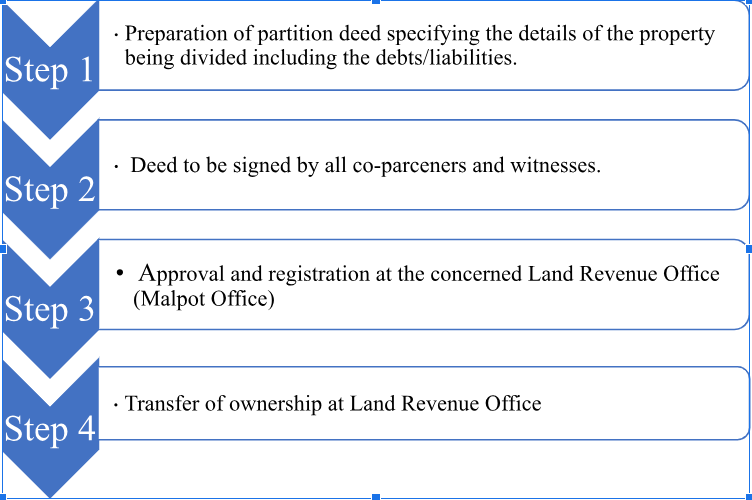
- Step – 1: Preparation of partition deed (Banda Patra). This deed must specify all details of the property being divided, the shares allocated to each co-parcener, and details of any debts or liabilities.
- Step – 2: The deed needs to be signed by all co-parceners and witnesses.
- Step – 3: It then needs to be approved and registered at the concerned Land Revenue Office (Malpot Office) to be legally valid and to transfer ownership.
- Step – 5: Transfer of ownership to each co-parcener of their respective shares at Land Revenue Office
Please note that for physical division of land, a survey may be required to demarcate individual shares. In cases where properties have varying values, the division should aim to balance high and low-value properties, with consent.
4.2 Court ordered partition
If co-parceners cannot reach a mutual agreement, any co-parcener can initiate a legal procedure for partition. This typically involves filing a partition case in the concerned District Court under section 234 and 235 of the Civil Code. The court will direct the division and ensure equitable distribution.
05. Legal Procedure for litigation
If a coparcener is denied or excluded from their rightful share, or if there's a dispute regarding property division, they can initiate a legal procedure for partition. The matter then will be formally dealt by the concerned District Court holding jurisdiction.
For this, the following steps can be taken:
5.1. Demand for Partition:
The aggrieved co-parcener should formally demand their share from the other co-parceners. This can be done verbally or they can serve a formal legal notice through an advocate, demanding partition.
5.2. Filing a Lawsuit:
If the demand is not met, the co-parcener can file a partition suit (Angsabanda Nalish) in the concerned District Court having jurisdictions. It can be either the district court where the property is located or the district court where the parties to the dispute are living.
The lawsuit will involve submitting a plaint (Firad) detailing the property, the relationship of the co-parceners, the refusal to partition, and the requested share. Along with the evidence of their co-parcenary status and the property in question (e.g., ancestral documents, land ownership certificates – Lalpurja etc).
5.3. Court Process:
5.3.1 Mediation/Conciliation: The court may first attempt to facilitate a settlement through mediation or conciliation, encouraging the parties to reach a mutual agreement. This is often a mandatory step.
5.3.2 Hearing and Evidence: If mediation fails, the court will proceed with hearings, allowing both sides to present their arguments and evidence. This may involve:
Gathering Documents- The court can order the Land Administration Office to provide relevant property documents.
Land Survey- In cases involving land, the court may order a survey by a licensed surveyor and a court official to accurately demarcate boundaries and assess values.
5.3.3 Judgment: Based on the evidence and legal arguments, the court will issue a judgment, ordering the partition of the property according to law. The court's decision is binding on all parties.
5.4. Enforcement of Judgment:
Once the court issues a judgment, it can be enforced through the concerned district court where property is located.
06. Important Considerations:
- Hiding Property: No person shall conceal or hide a property that is liable to partition as per Section 226 of Muluki Civil (Code) Act 2017. It has provisions to penalize co-parceners who attempt to hide or conceal property subject to partition. If such concealed property is discovered later, the concealing party may forfeit their right to that specific property and such property shall be partitioned between the other coparceners.
- Tentative time frame: The time duration for partition based on mutual agreement shall take up to one week whereas partition through court procedure may take up to 12 to 14 months depending on the case complexity.
- Legal Counsel: Given the complexities of property law, especially in cases of dispute, it is highly advisable for individuals seeking partition to consult with an experienced legal professional in Nepal. A lawyer can guide them through the legal framework, help gather necessary documents, represent them in court, and ensure their rights are protected.
07. Some landmark case laws:
Meera Dhungana and Meera Khanal Vs HMG Ministry of Law, Justice and Parliamentary Affairs (NKP 2052, D.N. 6013)
This one of the historical caselaw that commenced the point of legislative reform towards gender equality of women's right to property. The petitioners in this case challenged the constitutionality of section 1 and 16 of the chapter on partition share (Angshabanda) of National Code (Muliki Ain), 1963 (2020) which discriminates against the women's equal property right. The petitioner filed writ petitions challenging even though Article 1(1) of this constitution provides that all laws inconsistent with the constitution shall ipso facto be void in tune of Article 131, but the inconsistent laws are in existence till the date in their previous form on account of the respondent's lukewarm response to Article 131 of the constitution. However, the court's decision of this case was not so positive in this regard, yet the court's directive order opened the gate way of the genesis of legislative reform concerning gender justice.
Narayan Prasad Tharu v. Harendra Kumar Chaudhary and Others (073-NF-0032)
The major issue on this case was clarification on inheritance rights of a married daughter to her mother's property, distinguishing between partition and inheritance. The case addressed whether a married daughter could be considered the "nearest relative" for inheritance purposes over a step-son. The Supreme Court ruled that the marital status of a daughter does not disqualify her from inheriting her mother's share of property. It underscored that blood relation is the primary determinant for next of kin in inheritance and that the Constitution and laws prohibit discrimination based on marriage. This case reinforces the spirit of equal rights enshrined in the Civil Code which explicitly states equal coparcenary rights for daughters.
Sharadadevi Khatiwada Vs. Sabitridevi Khatiwada and others (NKP 2077, D.N. 10418)
The property acquired by the father or mother from any source is considered as inheritance for the children. It cannot be interpreted that the property acquired by the stepmother through a deed, dowry or any other means is considered as inheritance for her children and not for the children born from the stepmother's side.
Premprasad Timsina and others Vs. Ramananda Timsina (NKP 2075, D.N. 10035)
A deed of partition must be registered in accordance with the law to be recognized as valid. A deed of partition that has not been executed from the evidence of conduct, or that is said to have been made in a household that does not exist, cannot be used as a basis for establishing the date of partition.
The fact that it was self-acquired must be proven by the party making the claim in that regard. Unless otherwise proven, the court should presume that the property acquired while living in a single household is registered in the name of any of the co-owners, regardless of whether it is registered in the name of any co-owner.
If someone's personal property is blended with the ancestral property (subject to inheritance), such property also assumes the form of ancestral property, i.e. common property to which all the co-owners are entitled. This is a jurisprudential principle regarding shares. Therefore, for a property of private acquisition to be considered indivisible, it should not be blended with ancestral property that is also in common ownership of other co-heirs.
Manoharlal Agrawal Vs. Bhagawandas Agrawal (NKP 2080, D.N. 11138)
If the property that has been confirmed as private acquisition and the property claimed to be in the common property are in different forms and their existence is different, then the value of the property will also be different along with its existence. This will cause injustice to the party building the common property, that is, if the house is considered to be the common property when building a house on the common land, then the party building the house will suffer injustice.
The rights over the property that has a separate existence and value may also be different.
Only if the party who has acquired the property privately or built the house from private acquisition spontaneously transfers the property of his private acquisition to another party or relinquishes his ownership, the property can change in ownership and remain in the common property. However, as long as the person who acquired the property privately does not relinquish his ownership of the property, the property will remain private.
If it is proven that the house was built on the common property from private sources, the house will remain private, and if this cannot be confirmed, the house will remain in the common property.
Date of Publication: 24 June 2025.
Disclaimer: This article published at our website is just for information purpose only. It shall not be taken as the legal advice, advertisement, personal communication, solicitation or inducement. Bhandari Law and Partners or any of the team members of the firm shall not be liable for the consequence arising of the information provided. As the factual situation may be different on your case, thereof if you need further legal advice on the subject matter, please Contact Us.
Related Professionals:
contact us
Get in Touch with Our Legal Experts
Have a question or need legal assistance? Fill out our contact form and our team of experienced lawyers in Kathmandu, Nepal will get back to you promptly.
Please include your WhatsApp or Viber number in the phone section if you'd prefer a direct call from one of our legal professionals.
We are here to provide trusted legal support tailored to your needs.