Table of content
-
Property Law in Nepal: Key Highlights
01. Background
Property means any cash, goods, or work can be considered as property if they can be used or transacted, their title can be transferred through purchase, sale, or other means, or any benefit can be derived from them. Property law in Nepal governs the ownership, use, transfer, and inheritance of immovable, movable, tangible and intangible property.
It is one of the important component of Nepalese legal framework, deeply rooted in civil law principles, customary practices, and statutory provisions.
02. Governing Law on Property Law in Nepal
National Civil Code, 2017 (2074) ("NCC") is the primary law governing the property in Nepal.
03. Ownership and Possession of property
The NCC of Nepal provides a comprehensive legal framework for property rights, including the concepts of ownership and possession. While often used interchangeably in common parlance, they have distinct legal meanings and implications.
3.1. Ownership
Ownership is the most extensive legal right that person can have over a property. It is the state having or controlling over something. The ownership is recognized and protected by the law. NCC has provided following legal rights regarding the ownership;
The property owner shall have the following rights with respect to their property;
(a) To use the property,
(b) To sell, transfer, or otherwise alienate the title to the property to any person,
(c) To mortgage, pledge, or encumber the property in any manner,
(d) To deal with or transact in the property,
(e) To derive any form of benefit or profit from the property,
(f) To construct any physical structure, wall, or fence, delimit boundaries, alter the form of the property, or otherwise protect it,
(g) To utilize the land, subsoil, surface, or airspace above the land as deemed appropriate,
(h) To destroy, discard, or dispose of the property in any manner,
(i) To initiate or pursue legal proceedings concerning the acquisition, protection, or enforcement of rights in the property.
*Note: Ownership is generally considered to be for an indeterminate duration and does not typically end with the death of the owner; it is transferred to their legal heirs.
Kinds of property on the basis of Ownership
The NCC has classified properties based on ownership into various properties as given below;
a. Private Property
b. Property in Common
c. Joint Property
d. Community Property
e. Public Property
f. Government Property
g. Trust Property (Guthi)
3.2. Possession
Possession refers to the physical control or having custody of a property. The possessory right shall establish when an individual has intent to possess or having a control over the property. The NCC has incorporate the possessory right over the property.
3.2.1. Grounds for acquiring the possessory right
The individual can acquire the possessory right over the property on the following grounds;
(a) By retaining the property in the owner's individual capacity,
(b) By legally purchasing another person's property,
(c) By getting permission to possess property.
*Note: A possessory right will only be considered legally acquired if it is obtained in good faith, amicably, or publicly. An individual can possess the property either in person or through his or her agent.
3.2.2 Rights of a Possessor
A person, in the capacity of a possessor, shall, subject to law, have the following rights:
(a) To uninterruptedly possess the property in his or her possession, subject to the
laws in force or the contract, if any, entered into in relation to the property,
(b) To use any benefits of the property in his or her possession.
3.2.3. Conditions for extinguished of Possession
The possessory right of an individual shall get terminated on the following circumstances;
If the property get renounced,
If the property get transferred to others,
Or if the property is completely destroyed or rendered useless.
04. Partition of Property
Chapter 5 of NCC, includes the provisions regarding partition of the property in the context of Nepal. The chapter discuss on the following subject matters;
4.1. Who can claim for the property?
According to the chapter 5 of NCC, Section 205 has defined coparceners as the husband, wife, father, mother, son, and daughter for the purpose of the property apportionment. The coparceners can claim the property on the following grounds;
a. Son and daughter who are born from the parents whose matrimonial relationship is to be dissolved,
b. Obtain partition share from mother,
c. Obtain partition share from father or husband,
d. Obtain partition share by latter wife or child from part of father or husband
*Note: If any woman coparcener got pregnant during the partition of the property, the child given birth by that woman coparcener is also recognized as the coparcener and has right on the property share. If, the child born dead, the property share of that child shall equally divided on other coparceners.
4.2. When coparceners can get separated?
With the mutual consent between the core family members, they can get separated after the partition of the property at any period of time. Furthermore, on the following grounds coparceners can get separated;
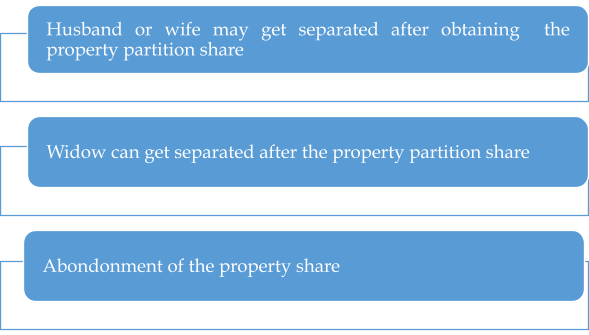
*Note: Any coparceners can relinquished the property partially or fully or in case of property can take cash or some kind in place of the property.
The relinquishment of the property share in case of the minor coparceners, cannot be exercised by the other coparceners.
The joint property shall be divided equally among the coparceners and shall be in the written form. During the partition of the property, the collective loan and property shall be equally divided among the coparceners.
05. Transfer Process of property in Nepal
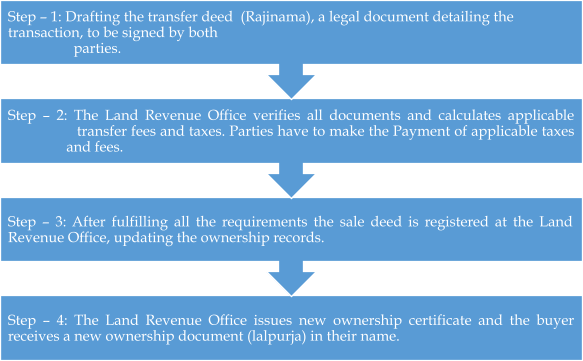
The transfer of property in Nepal could be done by the Land Revenue Office. The process of transferring of the property mainly involves following steps
- Step - 1: Drafting the transfer deed (Rajinama), a legal document detailing the transaction, to be signed by both the parties.
- Step 2: The Land Revenue Office verifies all documents and calculates applicable transfer fees and taxes. Parties have to make the Payment of applicable taxes and fees.
- Step 3: After fulfilling all the requirements the sale deed is registered at the Land Revenue Office, updating the ownership records.
- Step 4: The Land Revenue Office issues new ownership certificate and the buyer receives a new ownership document (lalpurja) in their name.
This is represented graphically as below.
* Note: On average, a straightforward property transfer can be completed within 1 to 2 days. However, more complex cases or those requiring additional verification may take longer, potentially extending to 15 to 30 days. It’s important to note that delays can occur due to unforeseen circumstances or administrative backlogs.
06. Tax applicable during transferring the Property
The following table explains about the amount of tax payable during the transfer of the property;
| S.N. | Particulars |
|---|---|
| 1. | Capital Gains Tax ("CGT"): Payable by the seller at 5% if the property has been owned for more than 5 years. The CGT is 7.5% of the profit if owned for less than 5 years. |
| 2. | Registration Fee: Usually up to 5% of the property valuation as per the government-assessed rate. |
| 3. | Local Tax: Some local bodies charge a local property transfer tax (up to 2%). |
| 4. | Property Tax (Malpot): This is an annual land tax that needs to be paid by the property owner. It's crucial to ensure all previous years' taxes are cleared before transfer. |
*Kindly, note that above mentioned fees and tax amount are tentative and is subject to change.
07. Property Valuation in Nepal
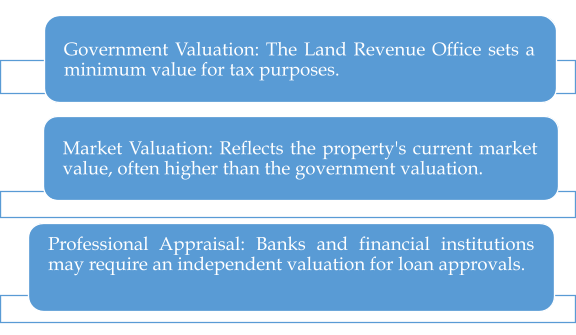
The valuation of the property is necessary for selling, mortgage and tax considerations. The government of Nepal use the Land Revenue Office to value the property using official rates, which are frequently less than market rates. Although banks or certified appraisers may conduct private valuations for loan or investment purposes, the official rate is utilized for legal purposes (tax calculation and registration).
The Commonly used methods for property valuation are;
08. Lease (Rental agreement) of Property in Nepal
The prevailing laws for lease and rental agreement in Nepal is under chapter -9, section (383-405) of NCC. Laws define rights and obligations for landlords (e.g., providing essential services) and tenants (e.g., paying rent, maintaining property).
a. Lease Agreement
The agreement should be in written form and should contains specific terms and conditions, specific period of time of execution and termination and specific rental amount.
However, a written agreement is not mandatory if the monthly rent does not exceed NPR. 20,000.
b. Tenant Rights
Tenants have rights against arbitrary eviction, and landlords must provide proper notice for termination before 35 days.
09. Ownership of property by foreigner in Nepal
There is a very strict law regarding foreign ownership over immovable property in Nepal to preserve national interest and land resources. Foreigners are not allowed to acquire any ownership over property. Non-resident Nepalese (NRNs) have more flexibility and can own limited residential property. Section 432 of the NCC of Nepal specifically prohibits immovable property transfers to foreigners without prior government approval. This clause forbids foreigners from acquiring land in Nepal.
There are, however, some exceptions;
- Foreign investors who set up a business in Nepal are able to buy property for their enterprise, as long as they do so through a company that is registered in Nepal.
- Through long-term leasing (up to 50 years), or via joint ventures with Nepali partners.
- Diplomatic missions and international organizations can acquire property with government approval.
Conatct us for consultation with Top Property Lawyers in Nepal
10. Resolution of Dispute in case of property
There are many causes that may lead to disputes over property, such as fights over inheritance, ownership claims, dispute over boundaries, contract violations, and landlord-tenant conflicts.
The disputes can be managed by both informal mechanism, i.e. Through Alternative Dispute Resolution ("ADR") and formal mechanism, i.e. Court Procedures.
The ADR consists of following procedures;
i. Negotiation: The first and frequently chosen approach is negotiation, in which parties try to settle the conflict directly and amicably.
ii. Mediation: Through communication facilitation and assistance in reaching a mutually agreeable solution, a mediator acts as a neutral third party. Mediation Act of 2011(2068) governs this procedure. Both private and court-annexed mediation are in practice.
Beside these alternative dispute resolution method, other formal means of dispute resolution such as Court litigation, local level judicial committee and quasi-judicial bodies can always be invoked.
Date of Publication:
Related Article: Property Partition Law in Nepal
Disclaimer: This article is published just for information purpose only. It shall not be taken as the legal advice, advertisement, personal communication, solicitation or inducement. Bhandari Law and Partners, a premier law firm in Nepal or any of the team members of the firm shall not be liable for the consequence arising of the information provided. As the factual situation may be different on your case, thereof if you need further legal advice on the subject matter, please Contact Us.
Related Professionals:
contact us
Get in Touch with Our Legal Experts
Have a question or need legal assistance? Fill out our contact form and our team of experienced lawyers in Kathmandu, Nepal will get back to you promptly.
Please include your WhatsApp or Viber number in the phone section if you'd prefer a direct call from one of our legal professionals.
We are here to provide trusted legal support tailored to your needs.