Divorce Lawyer in Nepal: Process, Grounds and Legal Help
1. Divorce Lawyer in Nepal
Ending a marriage is hard enough without having to work out the court process on your own. If you are looking for a divorce lawyer in Nepal, this page explains how divorce actually works under the Muluki Civil Code, 2074: which grounds the law recognises, what documents you need, how long it takes, and where a lawyer makes a real difference.
Bhandari Law and Partners has practised in Kathmandu since 1989. Our litigation team appears before the District Courts, the High Courts and the Supreme Court, and we handle divorce by mutual consent, contested divorce, property partition, maintenance and child custody. The law firm have professional lawyers to address the matter of divorce law in Nepal. You can message us on WhatsApp or Viber at +977 9808811027, or book a consultation.
02. Types of divorce in Nepal
Nepali law gives you two routes. Which one applies comes down to one question: does your spouse agree?
| Divorce by mutual consent | Divorce without consent (contested) | |
|---|---|---|
| Legal basis | Section 93, Civil Code 2074 | Section 94 (husband) or Section 95 (wife) |
| Who files | Both spouses, together | One spouse, against the other |
| What you must prove | Nothing. Both of you simply agree. | One of the grounds set out in the law |
| Typical time* | A few days once the documents are ready | Around 10 to 12 months, often longer |
| Court | District Court | District Court, with appeal to the High Court |
It shall take 3 to 5 days to complete the divorce process by mutual consent, whereas it may take 10 to 12 months as a tentative time, sometimes even more, in the case of divorce without mutual consent. So, the above-mentioned consideration is most important. Even divorce by consent can be obtained during the course of case proceedings before the court if both parties agree.
03. Who can file for divorce?
During client consultation, our divorce lawyer of Nepal finds a misconception regarding the initiation of divorce in Nepal. Most of the clients make the query that without the wife's consent, the husband cannot get a divorce. This perception is wrong. Divorce can be initiated either by the husband or the wife. The divorce law of Nepal has no restriction on the same.
04. Divorce by mutual consent: the steps
What we do
This is the quicker route, and the one most couples want once they have both decided to separate. For the full procedure, see our guide to the divorce process in Nepal.
-
Talk to our divorce lawyer first. We check that you both really agree, and go through what needs settling: who keeps which property, who the children live with, and whether anyone pays maintenance.
-
Gather the documents (the list is further down).
-
We draft the joint petition. It records your agreement in writing, so the court can see the terms were thought through.
-
File at the District Court. Both spouses sign, and both appear as the court requires.
-
The court checks that the consent is genuine and freely given, then issues the divorce order.
Once your papers are complete, we usually finish this in around three to five days. If you and your spouse have not yet agreed on property or the children, that part takes longer, and it is better to settle it before you file.
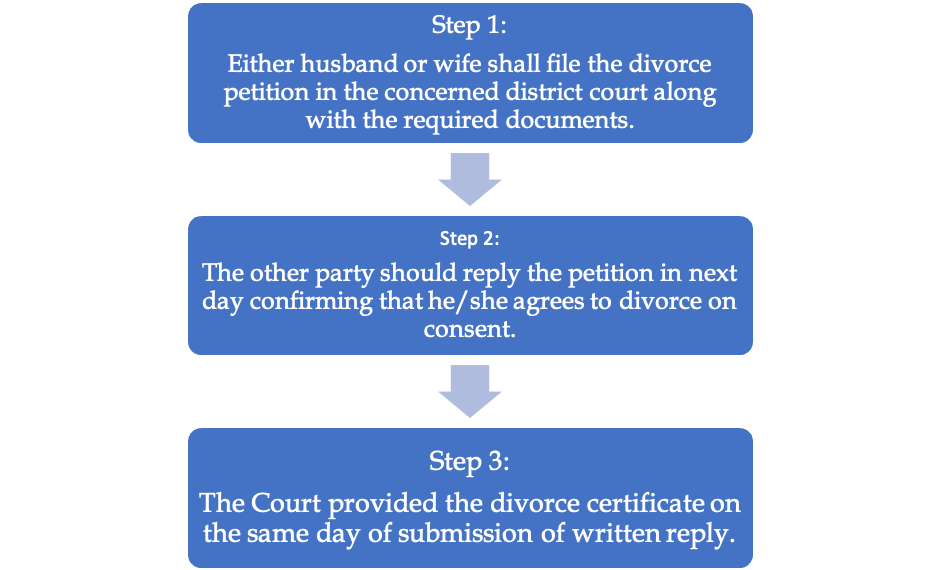
Divorce by mutual consent: the steps
Step 1 : Either husband or wife shall file the divorce petition in the concerned district court along with the required documents.
Step 2 : The other party should reply the petition in next day confirming that he/she agrees to divorce on consent.
Step 3 :The Court provided the divorce certificate on the same day of submission of written reply.
Once your papers are complete, we usually finish this in around three to five days. If you and your spouse have not yet agreed on property or the children, that part takes longer, and it is better to settle it before you file
05. Divorce without consent: the steps
What we do
-
Case assessment : We look at your grounds and at the evidence you actually have. A ground you cannot prove is not much of a ground.
-
Petition : We draft it and file it at the District Court with the court fee. You can estimate the fee with our court fee calculator.
-
Notice and reply : The court notifies your spouse, who gets the chance to respond in writing.
-
Hearings and evidence : Both sides present documents and witnesses. The court may encourage a settlement along the way, and some contested cases end here by agreement.
-
Judgment : The court decides on the divorce, and on property, maintenance and custody where they are in dispute.
-
Appeal : Either side can appeal to the High Court within 35 days of the decision.
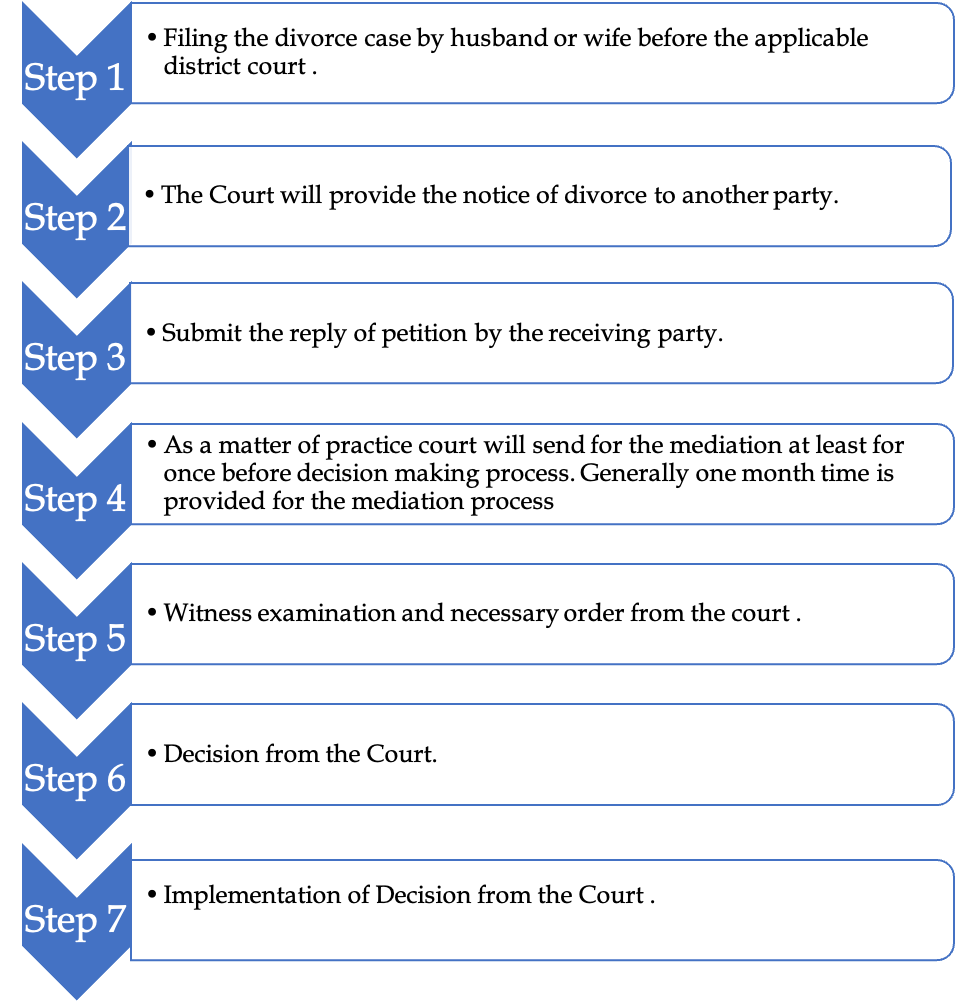
Divorce without consent: the steps
Following process has to be followed for filing the divorce case without consent:
Step 1 : Filing the divorce case by husband or wife before the applicable district court.
Step 2 : The Court will provide the notice of divorce to another party.
Step 3 : Submit the reply of petition by the receiving party.
Step 4 : As a matter of practice court will send for the mediation at least for once before decision making process. Generally one month time is provided for the mediation process
Step 5 : Witness examination and necessary order from the court.
Step 6 : Decision from the Court.
Step 7 : Implementation of Decision from the Court.
Plan for 10 to 12 months, and sometimes more. The cases that run longest are usually the ones where property or the children are disputed.
6. Documents Required For Divorce Process in Nepal
Following documents are required to intiate the divorce process :
| S.N. | Documents required |
|---|---|
| 1. | A copy of citizenship of both husband and wife |
| 2. | A copy of marriage registration certificate (if not then, photos of marriages conducted through rituals shall work) |
| 3. | A copy of birth certificate (in case of children under 16) or citizenship certificate |
| 4. | 2 copies of passport size photos of husband and wife |
07. Property, maintenance and children
Property
Property from the marriage is dealt with under the Civil Code's partition rules (Section 99). In a divorce by consent, you settle it between you and write it into the agreement. In a contested case, the court decides.
Maintenance
A spouse can claim maintenance under Section 100. It is not automatic. The court looks at the circumstances, including who depends on whom.
Children
Custody follows what is best for the child (Section 115). In practice, very young children usually stay with their mother, and an older child's own wishes carry weight. If you are divorcing by consent, agree this in writing.
08. If you or your spouse live abroad
Many of our clients are Nepalis working overseas, or couples where one spouse is a foreign national. Being abroad does not stop a divorce, but it changes the practical steps: how documents are signed and verified, and whether you must attend a hearing. Tell us your situation on the first call and we will set out exactly what is needed.
One caution. A divorce order from a Nepali court is not automatically recognised in every country. If you plan to remarry abroad, check the rules there as well.
09. How much does a divorce lawyer cost in Nepal?
There is no single fee, because the work differs so much from case to case. A divorce by consent with complete documents is a short, contained piece of work. A contested case can run through many hearings over a year or more, and longer if it goes to appeal.\
Three things move the cost the most: whether your spouse agrees, how many hearings the case needs, and whether property or custody is disputed. Court fees are separate from lawyer fees, and our court fee calculator gives you an estimate. We give you a clear fee quote at the first consultation, before you decide to go ahead.
10. What a divorce lawyer actually does
On paper, a lawyer files a petition. In practice, the useful part is everything around it. A divorce lawyer in Nepal will:
-
tell you honestly which route fits your situation, and whether your grounds will stand up;
-
prepare the petition and the agreement properly, because incomplete or badly worded papers can be sent back and cost you weeks;
-
deal with the court, and with your spouse's side, so you do not have to;
-
protect your position on property, maintenance and the children, which is where the long-term consequences sit; and
-
where it makes sense, help the two of you settle outside the courtroom.
10. Why clients choose Bhandari Law and Partners
-
We have practised in Kathmandu since 1989.
-
Our litigation team is led by Advocate Thahar Bahadur Bhandari, with more than 30 years in practice. You can see the rest of our team of lawyers here.
-
We appear before the District Courts, High Courts and Supreme Court.
-
You can reach us by phone, WhatsApp, Viber or email, and our office is at Park Lane Road, Buddhanagar-10, Kathmandu.
-
What you tell us stays confidential.
10. The Role of a Divorce Lawyer in Nepal
Generally, a person may not have a proper understanding of divorce law in Nepal. To get them out of the confusion, the divorce lawyer's role comes into play. During the divorce process in Nepal, issues related to (i) division of property, (ii) child custody, (iii) alimony, and (iv) sometimes domestic violence also arise. Their expertise in this field allows divorce lawyers in Nepal to provide advice and representation in the dispute.
Moreover, many divorce lawyers in Nepal have extensive experience dealing with diverse cases. This experience equips them with the knowledge and skills necessary to navigate even the most challenging divorce scenarios. Divorce lawyers assist clients in understanding the necessary paperwork, filing petitions with the appropriate court, and adhering to procedural requirements throughout the process. From drafting divorce petitions to gathering evidence and presenting arguments in court, these legal professionals handle all aspects of the legal proceedings on behalf of their clients. Their goal is to ensure that the divorce process is conducted efficiently and effectively, with the best interests of their clients in mind.
In many cases, divorce lawyer also facilitate mediation and negotiation between spouses to reach a mutually acceptable settlement outside of court. Through mediation, they help parties identify common ground, communicate effectively, and resolve disputes amicably.
Last updated: 28, September 2026
Date of Publication: 21 March 2024
Disclaimer: Bhandari Law and Partners is one of the leading law firm in Nepal with team of best professional lawyers in Nepal.This article published on website of the law firm is just for information purpose only. It shall not be taken as the legal advice, advertisement, personal communication, solicitation or inducement. Bhandari Law and Partners or any of the team members of the firm shall not be liable for the consequence arising of the information provided. As the factual situation may be different on your case, thereof if you need further legal advice on the subject matter, please Contact Us.
Related Professionals:
contact us
Get in Touch with Our Legal Experts
Have a question or need legal assistance? Fill out our contact form and our team of experienced lawyers in Kathmandu, Nepal will get back to you promptly.
Please include your WhatsApp or Viber number in the phone section if you'd prefer a direct call from one of our legal professionals.
We are here to provide trusted legal support tailored to your needs.